Guides
Does a Medical Courier Need a HIPAA Business Associate Agreement?
A medical courier HIPAA business associate agreement is required when you create, receive or transmit protected health information for a covered entity.
What to take away
- A courier needs a BAA when it creates, receives, maintains or transmits protected health information on behalf of a covered entity, per the definition at 45 CFR 160.103.
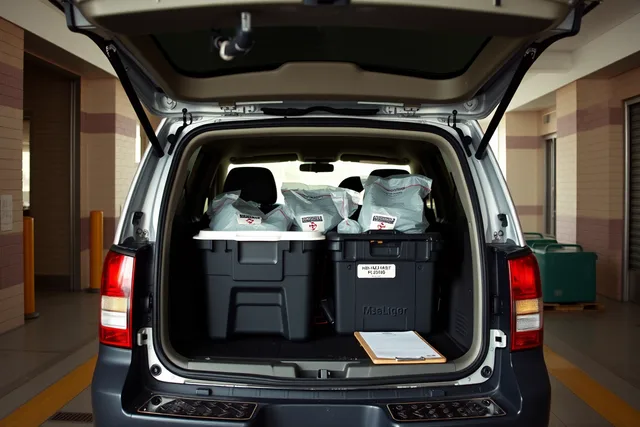
- A courier that only picks up a sealed tote and never opens it may still be a business associate, because possession counts as receiving PHI.
- HIPAA is federal. State lab rules and private lab contracts sit on top of it, and they often demand more than the federal floor.
- Skipping the agreement does not just void paperwork. It exposes the courier to civil money penalties that HHS sets and adjusts each year.
- The BAA is signed before the first specimen moves, not after a lab asks for it during an audit.
Who has jurisdiction over a courier BAA
Three layers of rules apply to a courier hauling specimens, and they do not always agree.
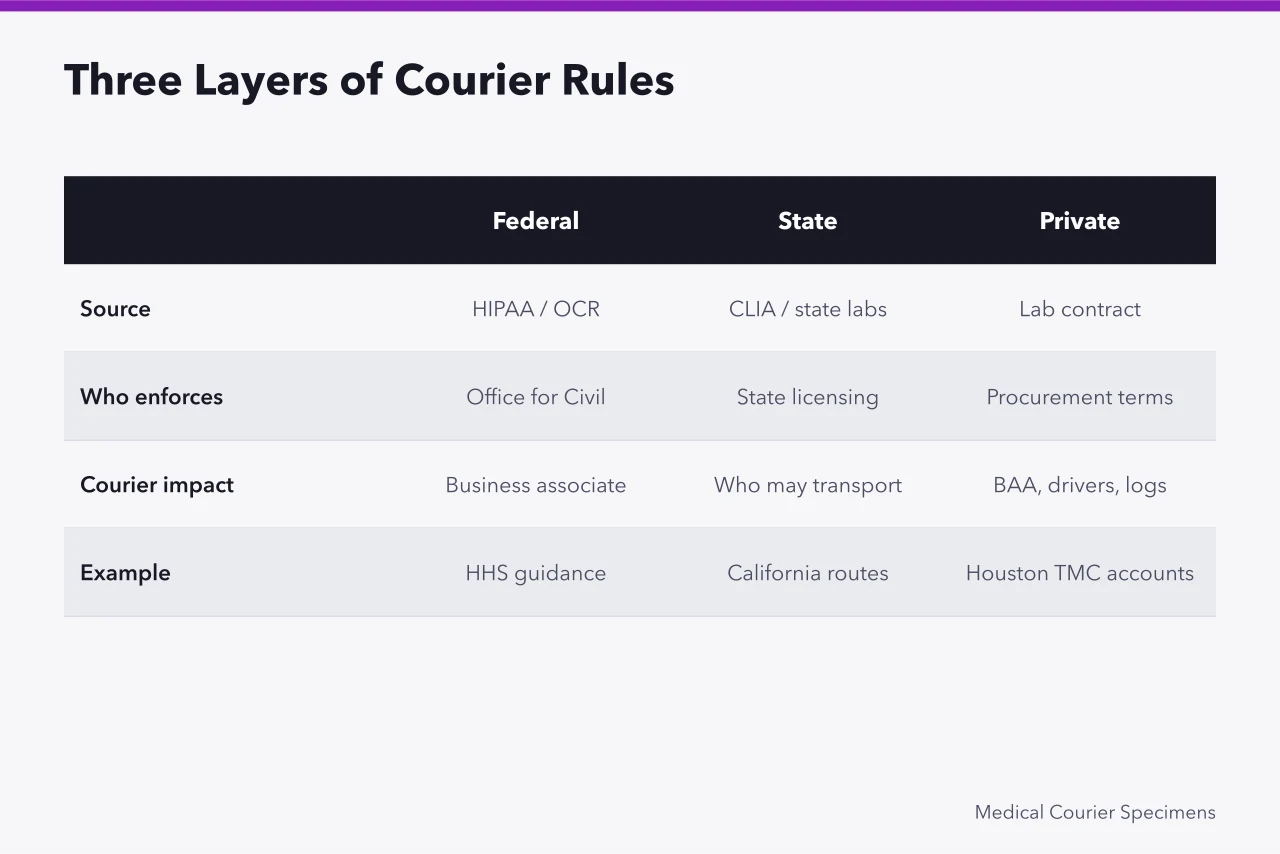
The federal layer is HIPAA itself, enforced by the Office for Civil Rights at HHS. The agency's own guidance states that a person who transmits PHI for a covered entity is a business associate, and that includes a courier. Read the HHS business associate guidance before you argue the point with a lab.
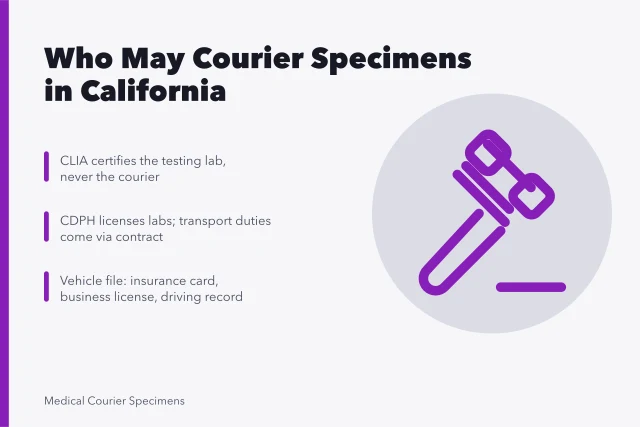
The state layer covers laboratory operations. CLIA sets the federal floor for testing, but states license labs and sometimes regulate who may transport specimens. California is the clearest example, and the CLIA and state lab rules that decide who can courier specimens in California are worth reading before you bid on a route out of a hospital lab there.
The private layer is the contract. A lab's procurement terms can require a signed BAA, named drivers, temperature logs and a certificate of insurance before a single run is dispatched. Texas Medical Center accounts in Houston run this way, and the vetting process for Houston specimen couriers shows how much of it happens before pricing is discussed.
What triggers a business associate agreement
The trigger is not a specific vehicle, route or cargo box. The trigger is the relationship and the data.
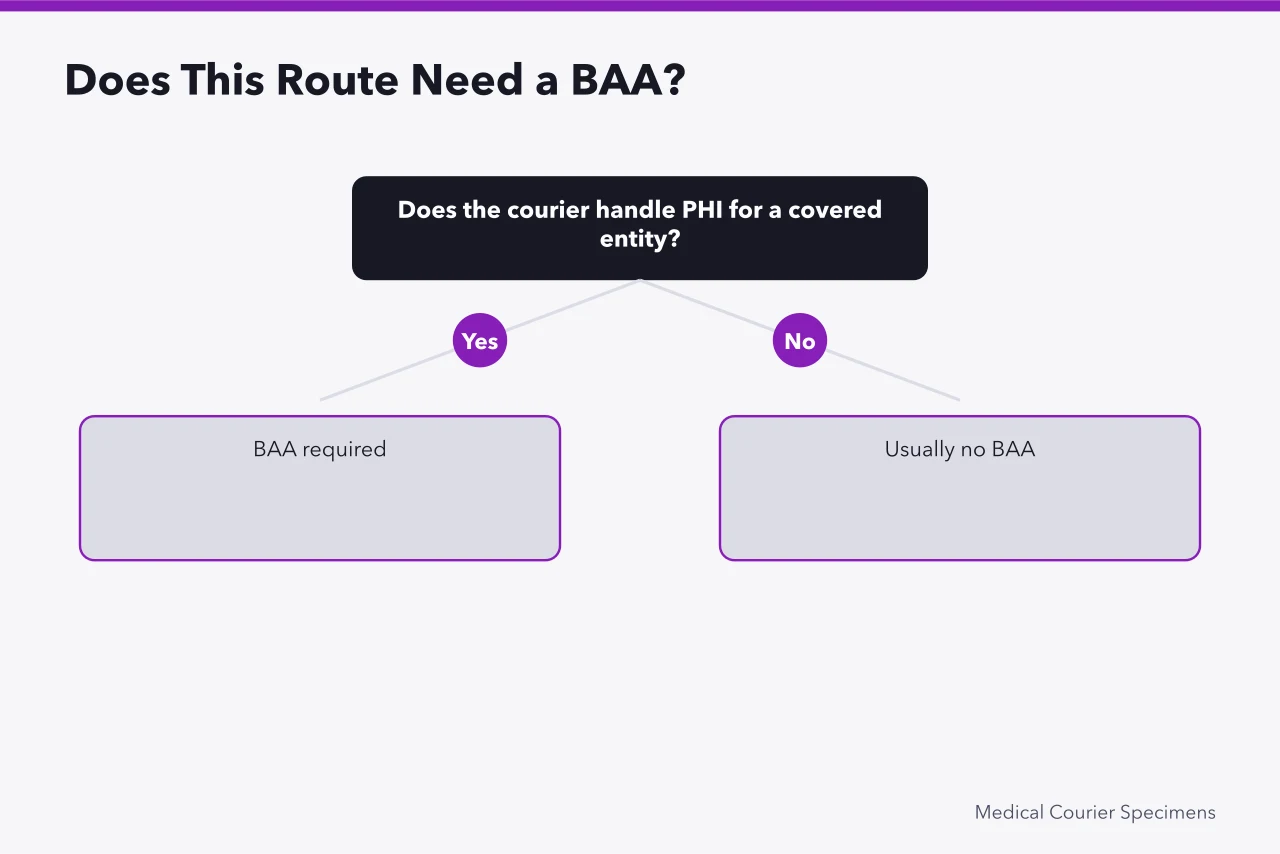
A courier becomes a business associate when it performs a function involving PHI for a covered entity, or when it provides a service to a business associate that involves PHI. Transporting a specimen with a patient label attached is the obvious case. So is handling a manifest that lists patient names and test orders.
| Situation | BAA typically required | Why |
|---|---|---|
| Sealed tote, no manifest, no labels | Often yes | Possession of PHI still counts as receiving it |
| Driver reads patient labels to sort | Yes | PHI is accessed, not just moved |
| Courier app stores pickup addresses and names | Yes | PHI is maintained in a system you control |
| Courier only hauls empty containers | Usually no | No PHI involved |
| Subcontractor driver on your route | Yes | Downstream contractors inherit the obligation |
That last row catches small operators. If you use contract drivers, the subcontractor provision applies to them, and you are the one who has to paper it. The contract terms that prevent disputes cover how to write those downstream clauses so a driver cannot quietly create a breach you own.
What a courier BAA has to contain
HHS does not publish a single mandatory form. It publishes required elements, and the contract has to satisfy them.
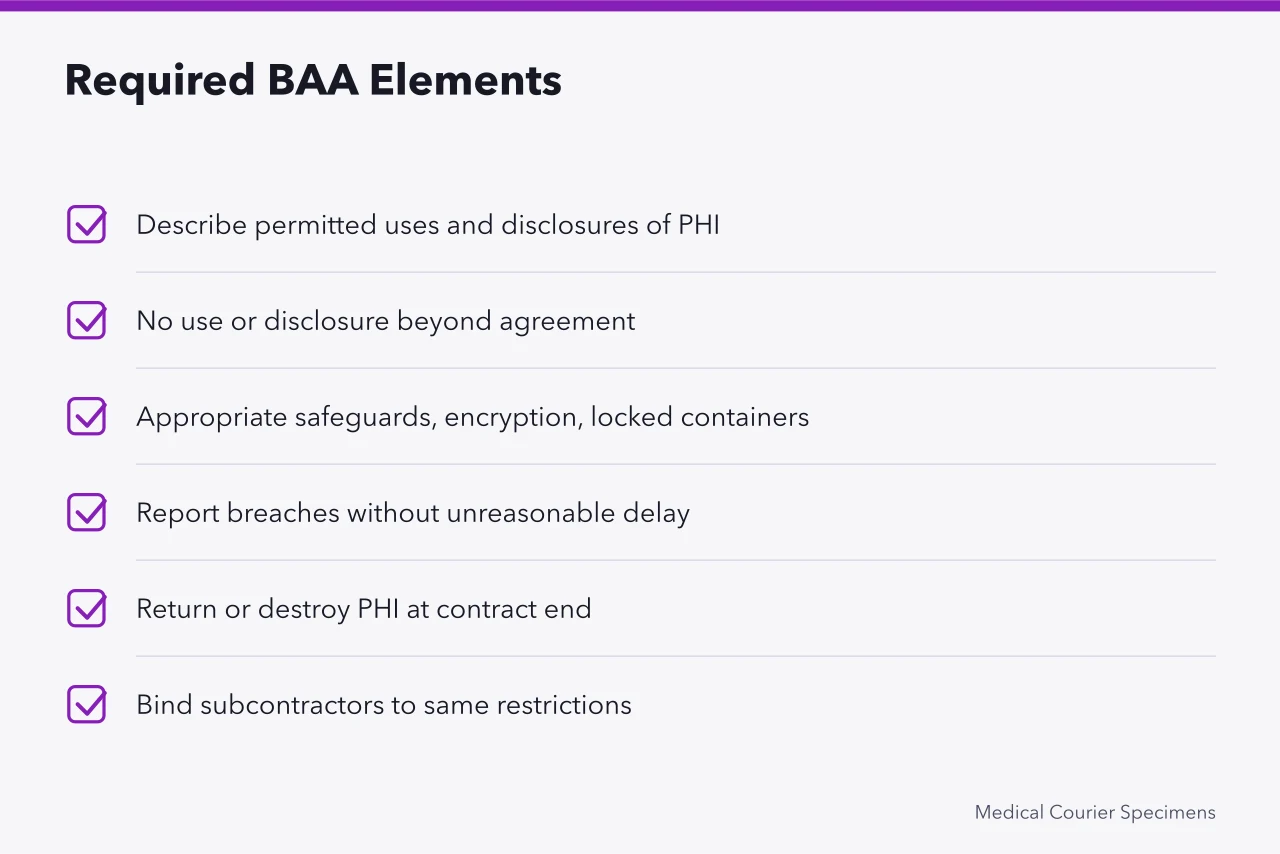
- Describe the permitted uses and disclosures of PHI, limited to the courier work itself.
- State that the courier will not use or disclose PHI beyond what the agreement allows.
- Require appropriate safeguards, including encryption or locked containers where PHI is stored.
- Require reporting of any breach or suspected breach to the covered entity without unreasonable delay.
- Require return or destruction of PHI when the contract ends, or an explanation of why that is not feasible.
- Require the courier to ensure any subcontractor agrees to the same restrictions.
A lab legal team will usually hand you its own template. Read the breach notification clause first. Some templates set a 24 hour reporting window, which is shorter than the federal standard and hard to meet if your drivers work nights.
How long approval takes
There is no permit office for a BAA, so approval moves at the speed of the counterparty.
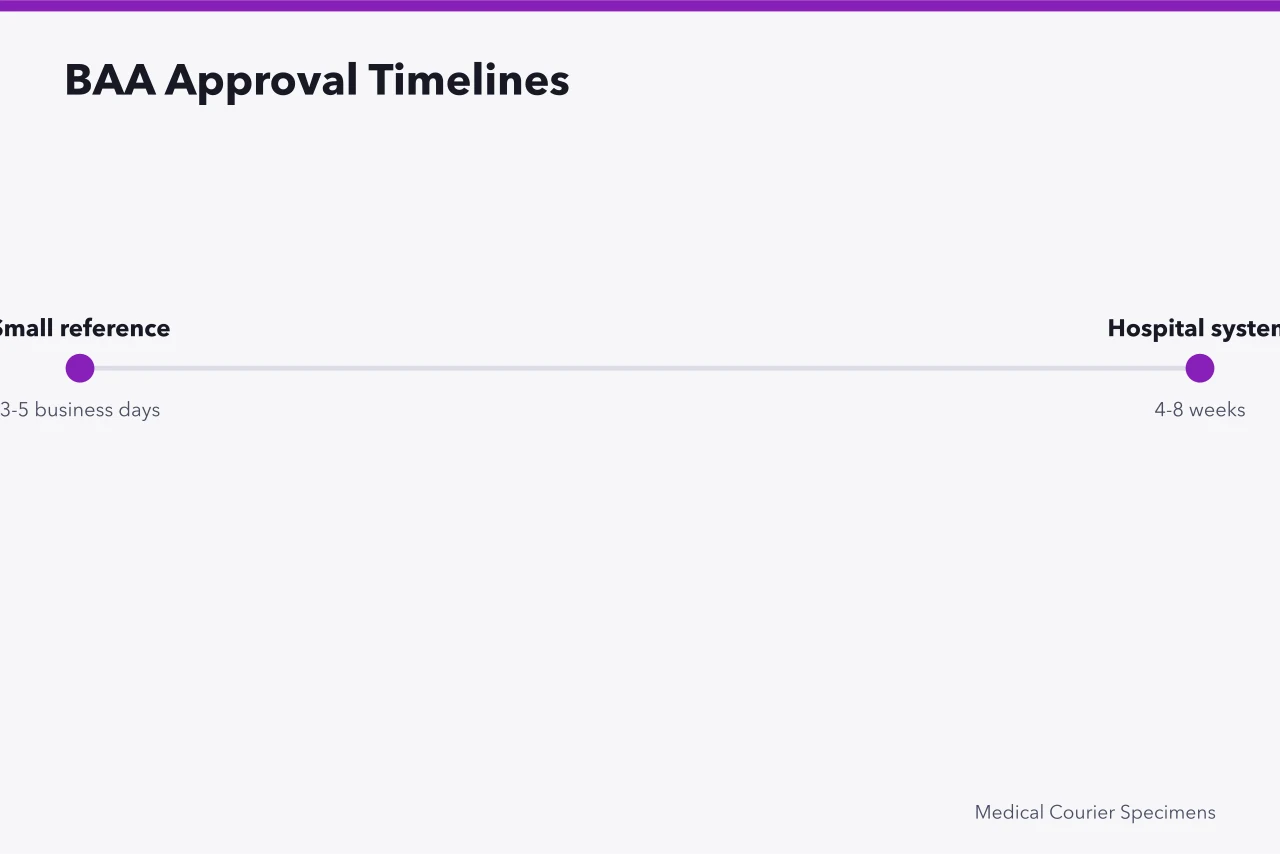
A small reference lab can turn a signed agreement around in three to five business days if it uses a standard template. A hospital system with an in house legal department may take four to eight weeks, and it may ask for your security policy, driver roster and insurance certificate in the same pass.
Build the paperwork before you bid. A courier that can produce a signed BAA, a driver list and a written breach procedure on day one wins routes that a cheaper competitor loses on delay.
What happens if you skip it
Skipping the agreement is a compliance failure with a stated consequence, not a paperwork technicality.
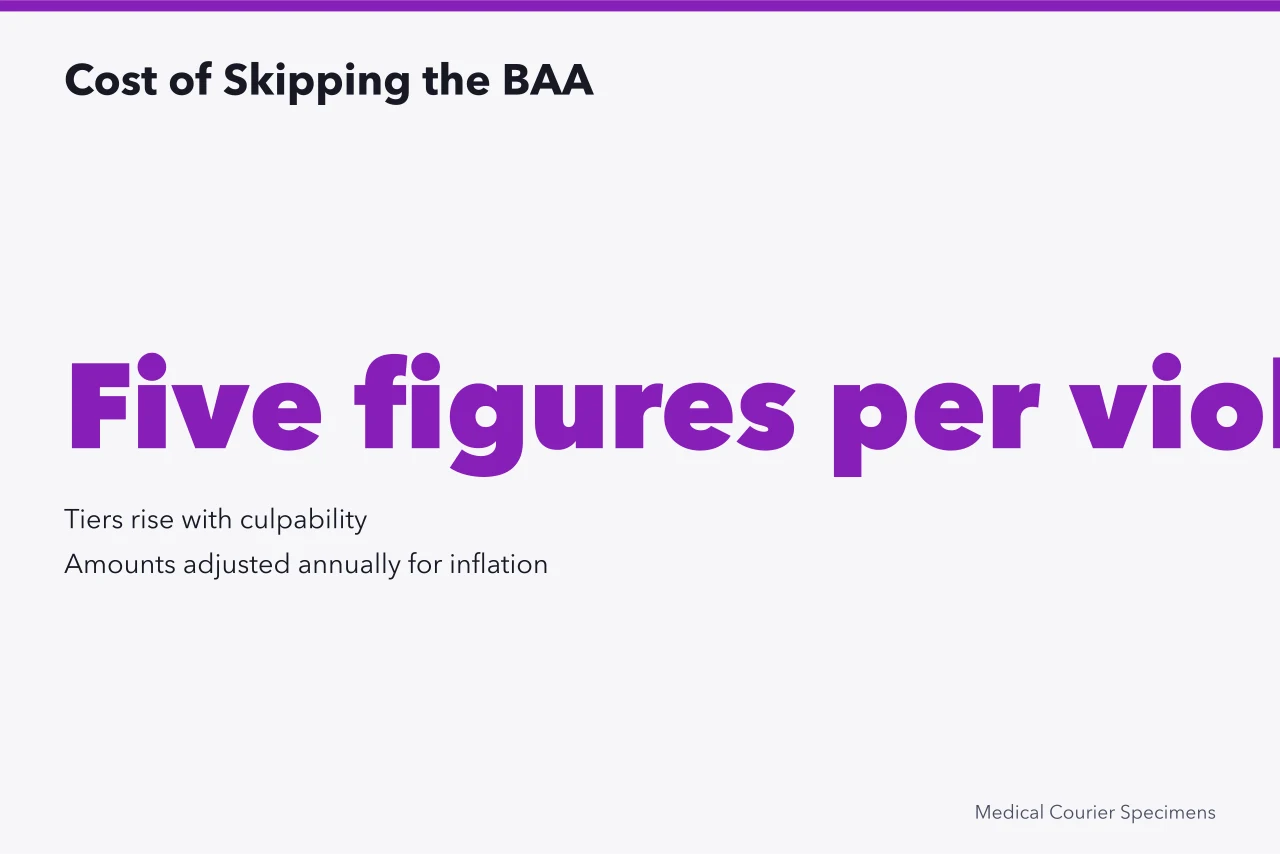
HHS can impose civil money penalties on a business associate that handles PHI without a compliant agreement. The agency adjusts those amounts annually for inflation, so check the current penalty table on hhs.gov rather than relying on a figure from an old blog post. A single violation can reach five figures, and the tiers rise with the level of culpability.
The practical damage arrives sooner. A lab that discovers an unsigned BAA during a vendor review will suspend the route, and the specimens still have to move. That gap is where a competitor gets a foothold.
Two more documents belong in the same folder. A specimen courier shipping Category A or B material needs DOT and IATA training records, covered in the DOT and IATA shipping rules, and those records are separate from the BAA. Drivers also need to know what to do at a dock, which is where the new courier training checklist is useful.
Common questions
Does every medical courier need a BAA? No. A courier that never touches PHI, for example one hauling empty coolers between a warehouse and a depot, is not a business associate. Once a patient label, manifest or specimen enters the vehicle, the answer flips.
Can a courier sign a BAA with a lab rather than a hospital? Yes. A lab is often a covered entity in its own right, and it can sign directly. If the lab is itself a business associate of a hospital, the courier becomes a subcontractor and the obligations flow down.
What if a driver is an independent contractor? The obligation does not disappear. The courier must ensure the subcontractor agrees to the same restrictions, which usually means a written agreement and documented training. The IRS test for contractor status is a separate question from HIPAA.
Does a BAA cover state privacy laws? Not automatically. State lab rules and state privacy statutes can add requirements. Check the state where the lab sits, not just the state where your depot sits.