Guides
Medical Courier 1099 vs W-2: What Owner-Operators Need to Know
1099 vs W2 medical courier driver classification hinges on IRS common-law factors and state ABC tests. California and Texas examples show the risk.
What to take away
- The IRS common-law test and state ABC tests decide 1099 versus W-2 status, not the contract title.
- California's ABC test is harder for couriers to satisfy than Texas common-law factors, especially for dedicated specimen routes.
- A 1099 driver bears self-employment tax and own vehicle costs; a W-2 driver shifts payroll tax and control to the courier company.
- Misclassification can trigger IRS back taxes and state penalties, including California's Private Attorneys General Act claims.
- Neither status removes duties for HIPAA compliance, training, cold chain handling, and vehicle recordkeeping.
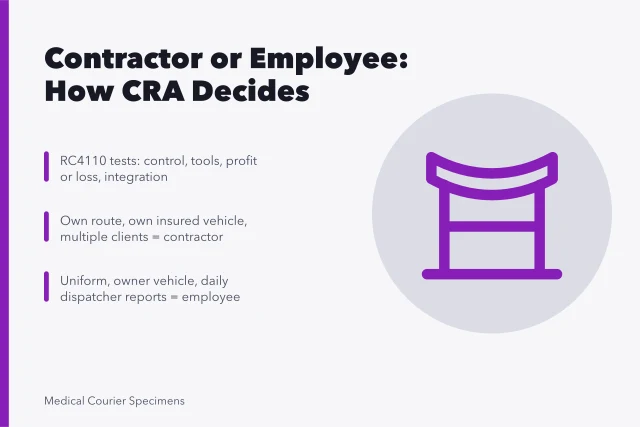
For a 1099 vs W2 medical courier driver decision, the starting point is not the contract label. The IRS sets common-law factors in its independent contractor guidance.
The two things being compared
The choice is between a 1099 independent contractor and a W-2 employee. A 1099 driver receives nonemployee compensation and no federal income tax withholding. A W-2 driver receives wages, tax withholding, and employer-paid payroll taxes. For medical courier routes that carry specimens, the distinction matters because the company's control over pickup windows, chain of custody, and patient privacy can push a driver toward employee status.
Criteria that matter for specimen couriers
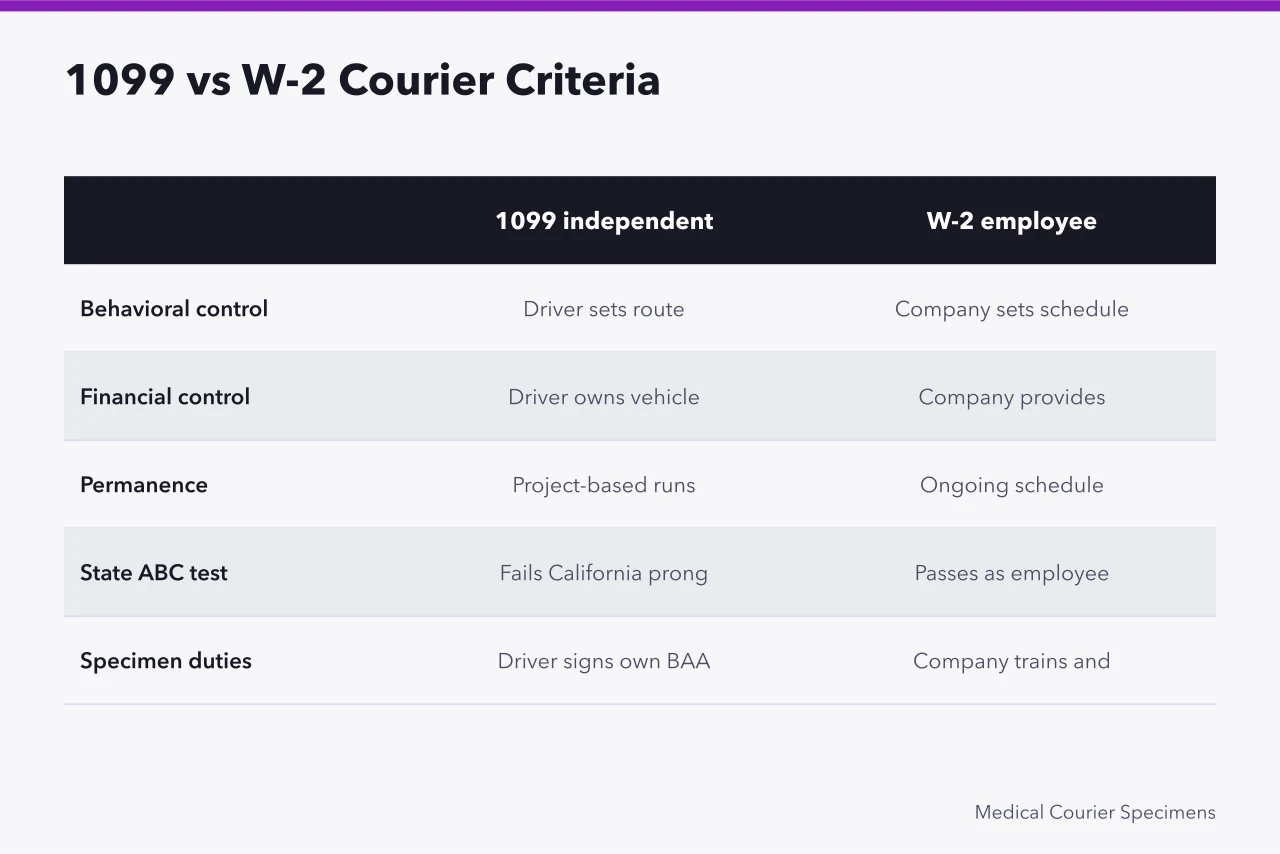
| Criterion | 1099 independent contractor | W-2 employee |
|---|---|---|
| Behavioral control | Driver sets route and methods; company gives only result | Company sets schedule, route, and handling steps |
| Financial control | Driver owns vehicle, pays fuel and insurance, can take other clients | Company provides vehicle or reimburses mileage, controls expenses |
| Relationship permanence | Project-based or per-run engagement | Ongoing schedule with benefits or PTO |
| State ABC test exposure | Fails California prong B if work is core to courier service | Passes because driver is treated as employee |
| Specimen-specific duties | Driver signs own BAA if needed and handles own training | Company trains, supervises, and signs BAA for workforce |
A written independent contractor agreement is not enough to make a driver a 1099. The facts of control matter more.
For the privacy side, HIPAA Business Associate Agreement applies regardless of classification.
State tests add another layer. California uses an ABC test that presumes a worker is an employee unless all three prongs are met. Texas follows the common-law factors without a statutory ABC presumption. That difference explains why identical courier routes can be classified differently in Los Angeles and Houston. A courier owner with routes in both states should review each state's wage orders and unemployment agency guidance before issuing a 1099 or W-2.
Option by option: 1099 independent contractor
A 1099 medical courier driver works for a fee per run or route. The driver pays self-employment tax, tracks mileage, and supplies a vehicle. This often suits a driver who runs for multiple labs, clinics, or courier services and controls when and how to work. It reduces the courier company's payroll administration and workers' compensation premiums. But it does not reduce the company's obligation to protect patient information or to train the driver on specimen handling.
For tax reporting, the courier company files Form 1099-NEC if compensation reaches $600 in a year. The driver reports the income on Schedule C and pays self-employment tax.
For routes crossing state lines, a driver should also review DOT and IATA rules.
Option by option: W-2 employee
A W-2 medical courier driver works under the company's direction. The company withholds income tax, pays half of Social Security and Medicare taxes, and often provides a vehicle or reimburses mileage. A W-2 driver can be required to follow a set route, wear a uniform, and complete specific training. For specimen couriers that means the company can enforce chain-of-custody steps and cold chain procedures more directly. The tradeoff is cost and administrative burden: payroll, overtime, workers' compensation, and unemployment insurance.
After hiring, owners use the medical courier business employee checklist to standardize specimen handling.
Example: California and Texas courier classifications
A 1099 arrangement is the right answer when a Texas medical courier owns a refrigerated van, contracts with several independent labs, and chooses which runs to accept. Texas applies the IRS common-law test without an ABC overlay, so a truly independent driver can remain 1099.
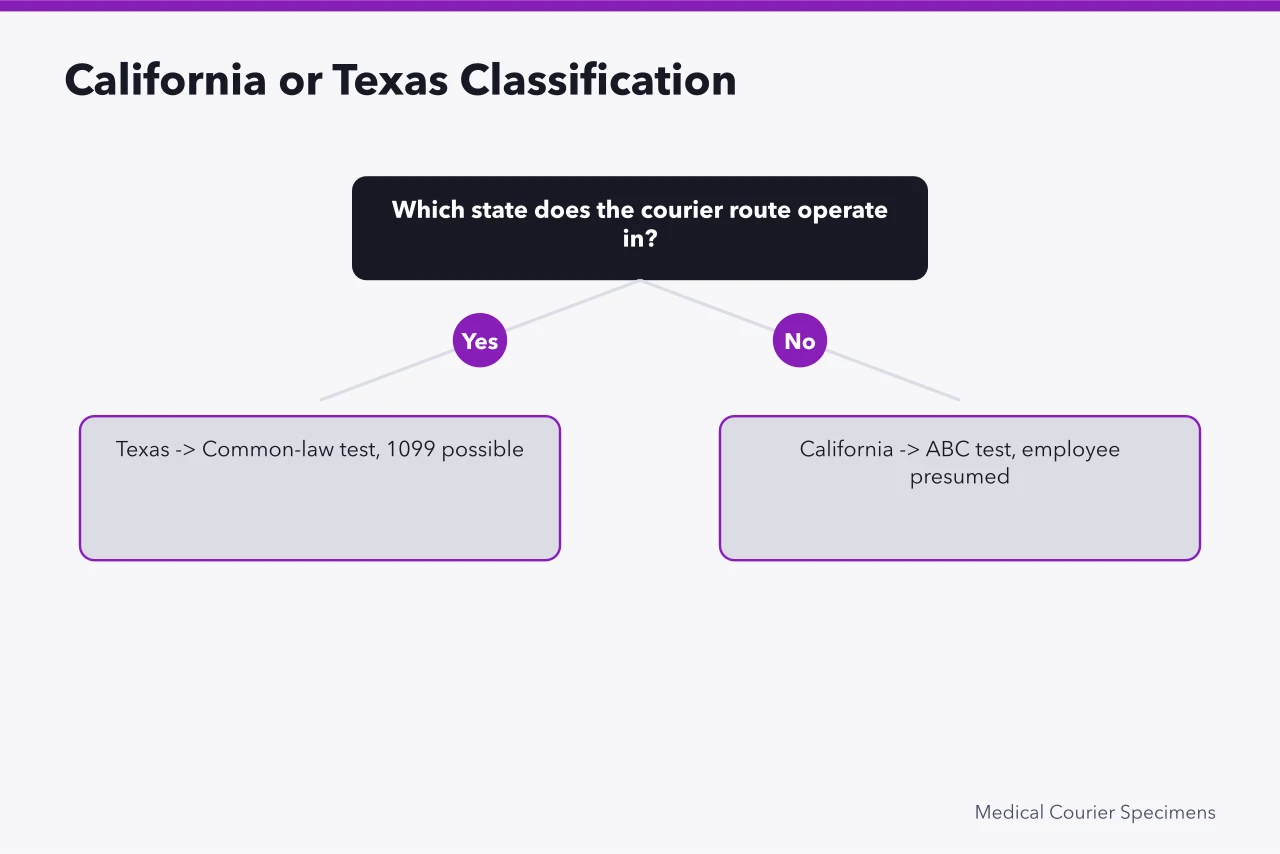
A W-2 arrangement is the right answer when a California courier company assigns a driver a dedicated route between a surgery center and a lab, requires pickup within 30 minutes, and prohibits work for competitors. California's ABC test presumptively treats that worker as an employee because the work is within the courier's usual business and the company controls the performance.
California's stricter test ties into CLIA and state lab rules.
What neither classification solves
Neither 1099 nor W-2 status changes federal privacy duties for a courier that encounters protected health information. A business associate agreement may still be required under HIPAA when a courier transmits or maintains PHI on behalf of a covered entity. The HHS business associate guidance explains when that agreement is needed. Neither status removes the need for cold chain packaging, specimen integrity, or vehicle sanitation. And neither status by itself gives a driver a defensible mileage record. Both 1099 and W-2 drivers should keep contemporaneous logs, as the IRS mileage guidance describes. This is a shared limitation: classification does not fix operational compliance.
Common questions
Does a 1099 medical courier driver need to sign a HIPAA business associate agreement? A driver who handles PHI on behalf of a covered entity may need a BAA, but the courier company often signs it and extends obligations through policy. The driver should confirm written authorization to access PHI.
Can a courier company use both 1099 and W-2 drivers for the same type of route? Yes, but the company must apply the same legal tests to each worker. If the facts differ, such as a route driver versus an owner-operator with multiple clients, different classifications can be defensible.
What happens if a California courier misclassifies a driver as 1099? The state can impose civil penalties and the worker may seek unpaid wages or expense reimbursement under the Labor Code. The IRS can also assess back payroll taxes and interest.
Is a written contract enough to prove independent contractor status? No. Courts and agencies look at actual control, not the label in the contract.