Guides
Medical Courier Contractor vs Employee: How the CRA Decides
Medical courier contractor vs employee Canada: how CRA's RC4110 tests and Ontario/BC employment standards decide status, with Toronto and Vancouver examples.
What to take away
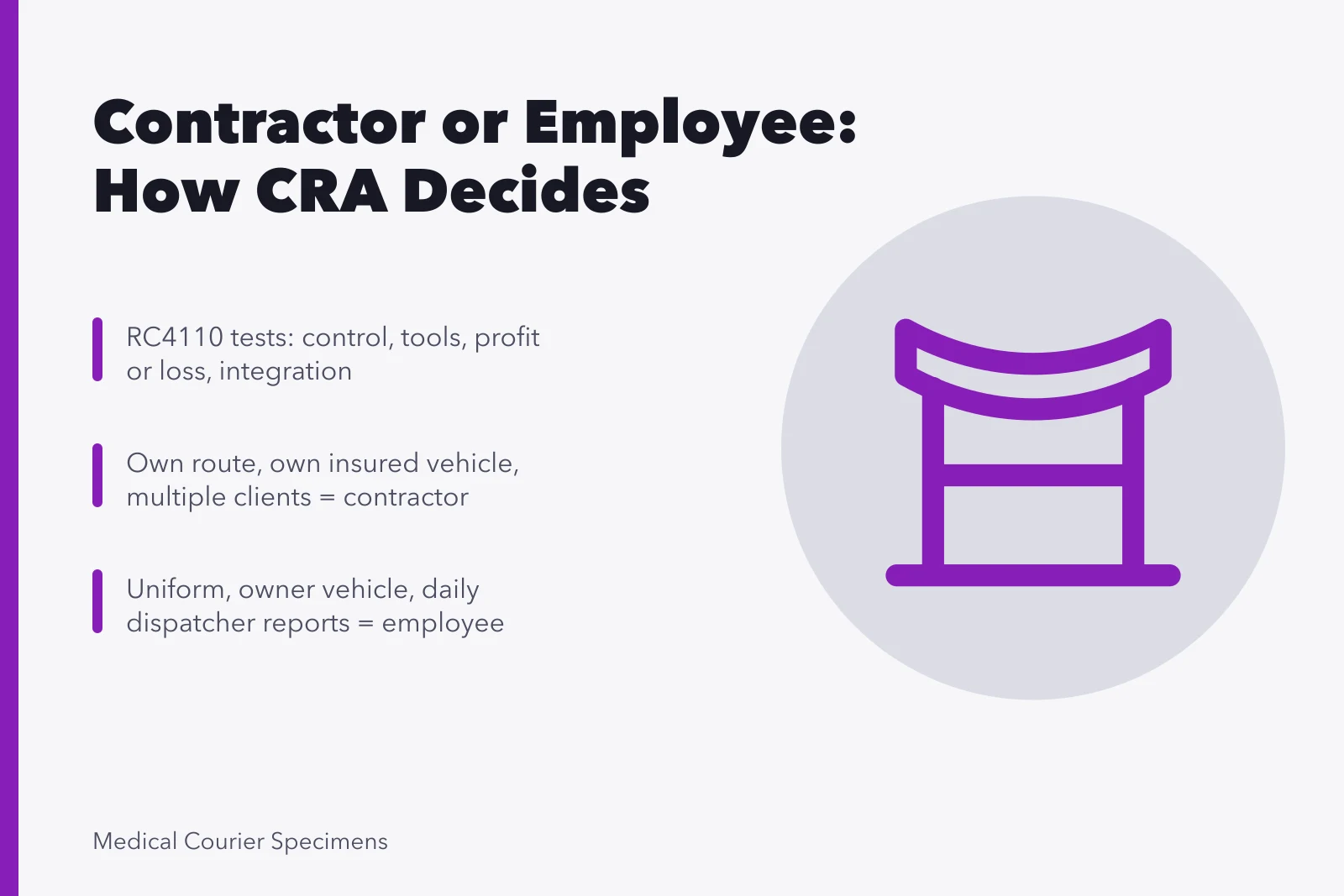
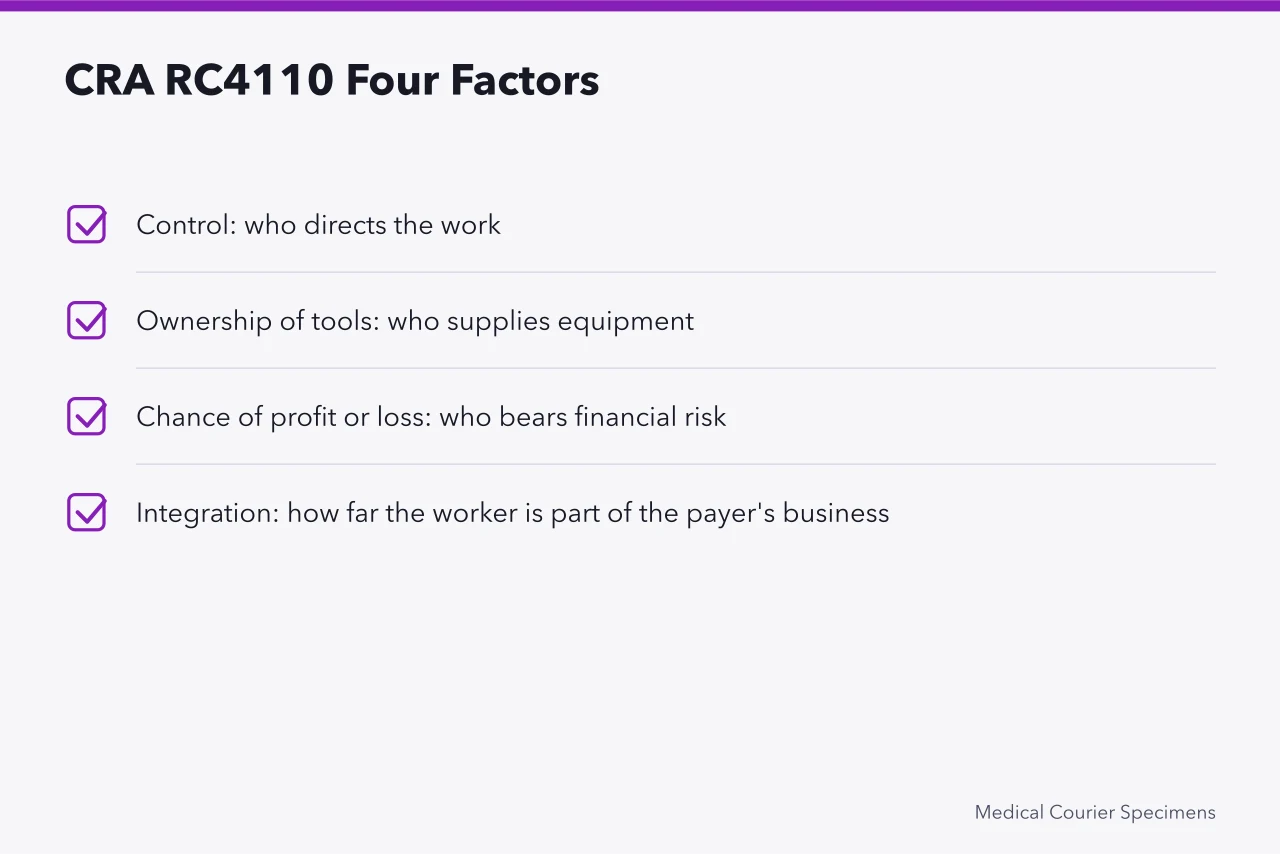
- CRA uses four main factors in Guide RC4110: control, ownership of tools, chance of profit or loss, and integration.
- A courier who sets their own route, supplies their own insured vehicle, and invoices multiple clients is usually a contractor.
- A courier who wears your uniform, uses your vehicle, and reports to your dispatcher daily is likely an employee.
- Provincial employment standards still apply, and Ontario and BC can reach a different result on things like overtime and vacation pay.
- Both classifications leave owner obligations around privacy and specimen handling unchanged.
The CRA's starting point
The Canada Revenue Agency does not rely on a single checkbox. Its Guide RC4110 asks whether the worker is in business for themselves or serving the payer's business. The four factors are control, ownership of tools, chance of profit or loss, and integration. No single factor decides the case. CRA weighs them together.
The payer's written contract matters less than what happens on the ground. CRA looks at the actual working relationship.
The current version of CRA Guide RC4110 describes each factor in detail.
Ontario and BC employment standards add another layer
Provincial laws ask a similar question but for a different purpose. Ontario's Employment Standards Act, 2000 and BC's Employment Standards Act cover minimum wage, overtime, vacation pay, and termination notice. An owner can follow CRA's ruling for tax and still face a provincial complaint. The provincial tests look at control, integration, and economic dependence, but each tribunal applies its own decisions.
For a Toronto route, an Ontario Ministry of Labour claim can proceed even if CRA accepted the driver as a contractor. For a Vancouver route, BC's Employment Standards Branch can reopen the same question. This is why classification should not be treated as one-and-done.
General background on independent contractor compares the common-law tests.
Criteria that matter for a courier owner
Written agreements help, but they cannot override the daily reality. Use these criteria to test a driver before you issue a T4 or T4A.
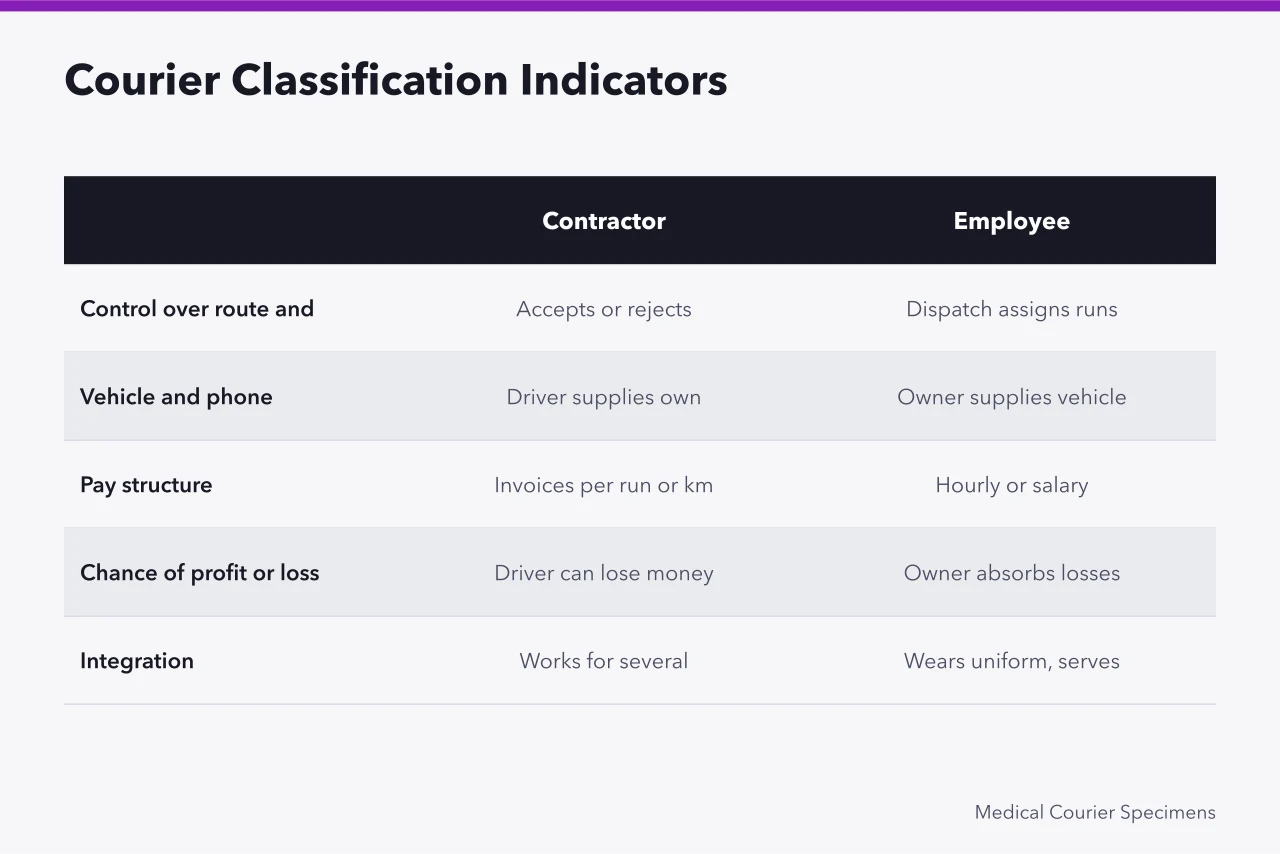
| Criterion | Contractor indicators | Employee indicators |
|---|---|---|
| Control over route and hours | Driver accepts or rejects runs, sets own order | Dispatch assigns runs and start times |
| Vehicle and phone | Driver supplies and maintains own vehicle and phone | Owner supplies vehicle, fuel, and dispatch app |
| Pay structure | Invoices per run or per kilometre, no guarantee | Hourly or salary, guaranteed minimum |
| Chance of profit or loss | Driver can lose money on fuel, insurance, deadhead | Owner absorbs all business losses |
| Integration | Driver works for several couriers and clinics | Driver wears owner's uniform and serves only that owner |
A clear written agreement can record who supplies what and who takes the risk. See contract terms for clauses that reduce disputes.
Example: Toronto incorporated driver with a single hospital route
Consider a Toronto courier who incorporated a numbered company and signed a service agreement. The owner provides a wrapped van, a phone, and a route that starts at Mount Sinai Hospital at 07:00 each day. The driver wears a company polo, follows a set sequence of lab pickups, and cannot hire a substitute without approval.

The incorporated company invoices the owner every two weeks and receives a set amount per route. CRA would likely find this worker an employee despite the corporation. Control, integration, and lack of chance of loss point that way. The Ontario Ministry of Labour would likely agree. This is the case where employee classification is the right answer.
If the worker is an employee, use the medical courier business employee checklist before the first run.
Many hospital routes in Toronto look like this. The incorporated driver still reports to a dispatcher. The owner still supplies the wrapped van and the patient list. CRA weighs those facts above the paperwork. The outcome is rarely borderline. Provincial wage claims follow the same control test. Do not treat the corporation as a cure. The real test is daily direction. That is why employee is the likely answer.
Example: Vancouver owner-operator with multiple clients
A Vancouver courier owns a cargo van, pays for commercial insurance, and uses a personal phone. She invoices three labs, a fertility clinic, and a pharmacy directly. She sets her own pickup order and can turn down a run.

She pays for fuel, parking, and repairs, and she can hire a relief driver at her own cost. CRA would likely find her a contractor under RC4110. She has a real chance of profit and loss. Her work is not integrated into any single payer's business. This is the case where contractor classification is the right answer.
Her hired and non-owned auto insurance obligations differ from an employee's.
Where each option wins
- Contractor classification wins when the driver has genuine control, supplies assets, invoices multiple clients, and can lose money. This works for long-haul specimen runs and overflow work.
- Employee classification wins when the owner needs a fixed route, branded uniform, strict schedule, and the ability to direct how specimens are handled. This works for hospital rounds and STAT work.
- Never present the worker as one type in writing and treat them as the other. That mismatch is the most common audit trigger.
Neither classification changes your privacy duties. See PIPEDA require for the specific obligations.
What neither option solves
Classification does not remove privacy and specimen-handling duties. A contractor who delivers lab requisitions still handles personal health information. The owner still needs a PIPEDA-compliant process, whether the driver is on payroll or invoices as a corporation. The federal PIPEDA statute sets out those duties.
Also, neither classification fixes poor packaging or missing temperature logs. Training and chain-of-custody rules apply to both. This shared limitation is why owners should treat classification as a tax and employment issue, not as a substitute for operational controls.
Common questions
Does incorporating a courier driver automatically make them a contractor? No. CRA looks past the corporation at the working relationship. An incorporated driver can still be found to be an employee for tax and provincial standards. Which test applies first, CRA or Ontario/BC? CRA decides payroll deductions and T4/T4A treatment. Provincial employment standards decide overtime, vacation, and termination. Both can apply to the same driver, and they can disagree. Can a driver be a contractor for tax but an employee for workers' compensation? Yes. Provincial workers' compensation boards use their own tests. An owner may owe premiums even if CRA says contractor. What penalty applies for misclassification? CRA can reassess unpaid CPP, EI, and income tax, plus interest and penalties. Provincial authorities can also order back pay for overtime and vacation.