Guides
Training a new medical courier business employee: the checklist
A medical courier training checklist in nine modules, each with what is taught, how competence is demonstrated, and what gets signed and retained.
What to take away
- Training is complete when somebody has demonstrated something, not when they have been told something. Every module below ends in a demonstration.
- Sign and date each module, per person. That record is what an auditor, an insurer and a laboratory will ask for, in that order.
- The refuse and escalate module is the one that decides whether the rest of the system works, and it is the one most often skipped because it is uncomfortable to teach.
- Refresh on a schedule and after any incident. A training record with no refresh dates is a record of what somebody knew a year ago.
Specific training requirements depend on the material, the mode and your state, and are set by federal agencies and by the contracting laboratory. Confirm yours with them; this page organizes the delivery and the evidence.
How to run it
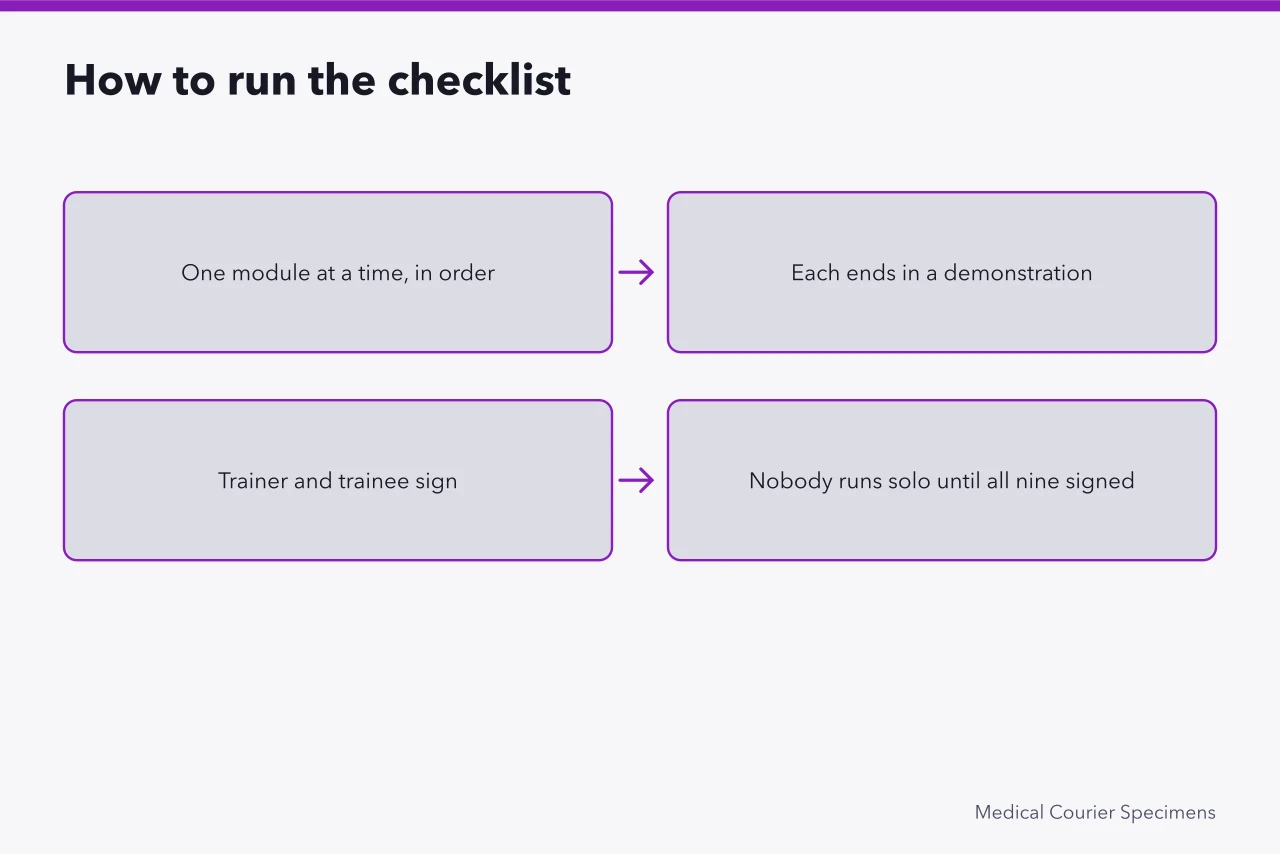
One module at a time, in order, each ending in a demonstration and a signature from the trainer and the trainee. Nobody runs solo until all nine are signed. The recruiting sequence that precedes this is in how to hire drivers who last, and the wider people system it belongs to is in the hiring and training guide.
Module one: what you carry and why it matters
Covers the material types on your routes, what each is for clinically, and what ruins one. Include the practical consequence: a compromised specimen means a patient is recalled and a result is delayed.
Demonstrated when the trainee can explain, without notes, what happens downstream if a specimen is lost or its condition is not maintained.
Module two: handover inspection
Covers what to look at before accepting anything: closure, external condition, labeling present, and whether the packaging matches what the account said it would be. Include what a failure looks like in practice, with examples they can handle.

Demonstrated when the trainee correctly identifies prepared failures among a set of containers.
Module three: refuse and escalate
Covers what to do when the inspection fails: do not transport, do not repackage without authority, contain, notify, record. Then role play it, twice, with somebody playing a busy and irritated staff member.
This is the module that makes the custody system real. A driver who will not push back at the counter will carry material that should not have moved, and no amount of paperwork downstream fixes that.
Demonstrated when the trainee holds the position through the role play and records it correctly afterwards.
Module four: transport rules for the role
Covers whatever applies to your material and your role: classification awareness, packaging and marking expectations, documentation and incident handling. What applies is set by PHMSA under the hazardous materials rules and by the contracting laboratory's own instructions. Establish the requirement with them before building the module, rather than assembling one from general material.
Demonstrated when the required course or instruction is completed and the record is held with a date.
Module five: exposure and spill response
Covers the written procedure, the contents of the kit, how to use it, who to call, and what is recorded. Practice it physically, in the vehicle, with the actual kit.
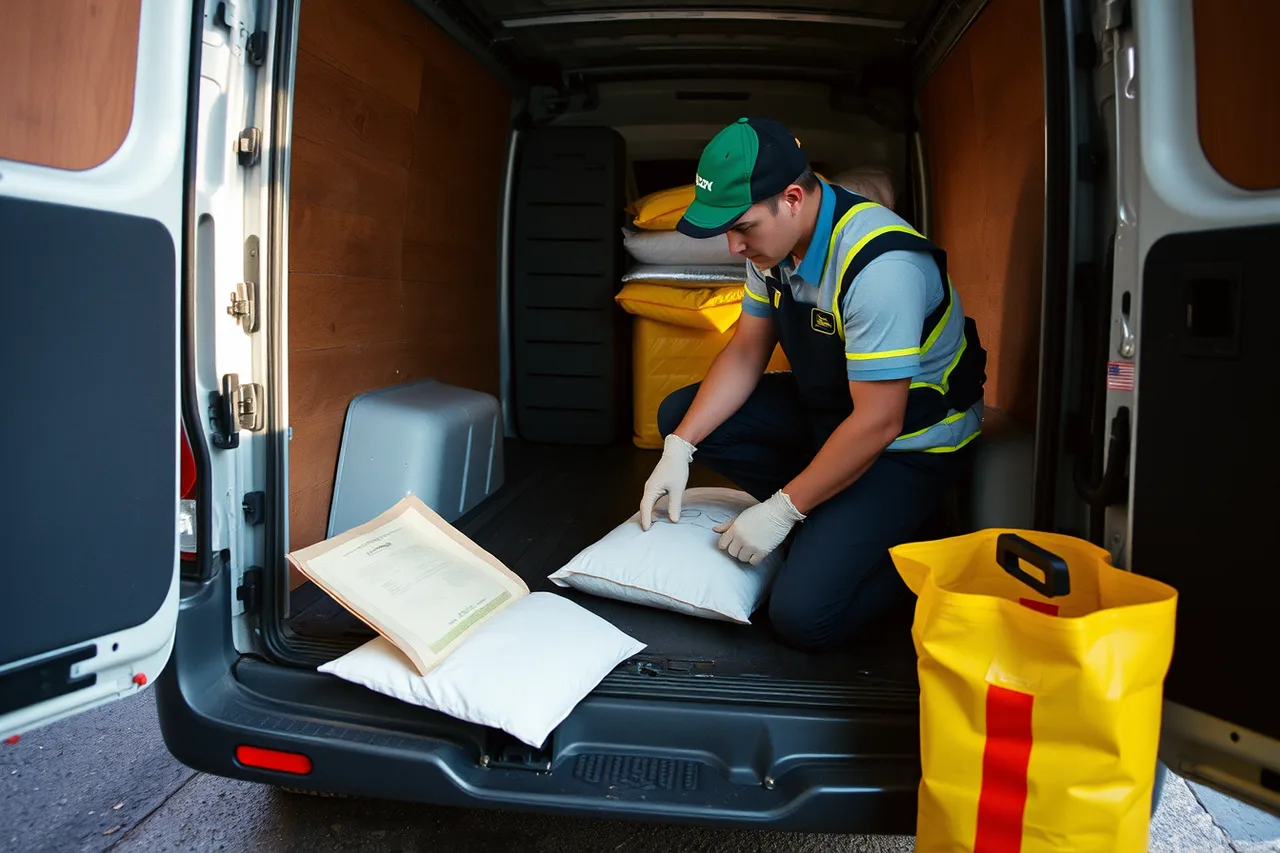
Demonstrated when the trainee runs a simulated spill from first action to completed report without prompting.
Module six: custody and condition records
Covers every field on the record, when it is completed, what to do about an exception, and how the record is transferred at the end of the run. Emphasize completing entries at the stop rather than reconstructing them later.

Demonstrated when the trainee produces a complete practice file for a full route that another person can read and reconstruct.
Module seven: privacy conduct
Covers documents kept out of view, devices locked, nothing photographed for convenience, and nothing discussed outside the job. Include what to do if a document or device is lost, and who is told immediately.
Demonstrated when the trainee signs an acknowledgment and can state the three things they would do after losing a device.
Module eight: site conduct
Covers behavior in clinical space: quiet, patient, unobtrusive in front of patients, using named contacts, and the waiting rule. Include parking and access at each specific site, which is knowledge rather than skill and is best transferred on the road.
Demonstrated when observed satisfactorily across a full ride along.
Module nine: the route and its constraints
Covers the sequence, each site's closing time, the constrained stop that cannot be missed, where the buffer sits, and what to do when a delay threatens the route. Include who to call and when, which is usually earlier than a new driver assumes.
Demonstrated when the trainee runs the route supervised, then solo with a file review afterwards.
The record to keep
| Field | Why |
|---|---|
| Person, module, date | The basic evidence anyone will ask for |
| Trainer name | Shows who assessed the demonstration |
| How competence was demonstrated | Distinguishes training from attendance |
| Version of the procedure taught | Procedures change; the record must say which one |
| Refresh due date | Turns refresh into a task rather than an intention |
| Any incident triggered retraining | Shows the system responds to what goes wrong |
Keep these per person, retrievable quickly. An operation that can produce a driver's full training record within minutes is treated very differently in an audit from one that has to reconstruct it.
Refresh and retrain
- On a fixed schedule for every module, with the date set when the module is first completed.
- After any incident, exception pattern or near miss involving that module.
- Whenever the written procedure changes, against the new version rather than by announcement.
- Whenever a new account brings a different protocol or a different material type.
Employment obligations sit alongside all of this: training time is working time. The wage, hours and recordkeeping position is set out in the Department of Labor guidance for new and small businesses. It covers minimum wage, overtime, hours worked and child labor standards, and notes that state law can add to the federal requirements.
Price those hours at the rate the role actually commands in your area. The BLS occupational employment and wage tables give national, state and metropolitan estimates. Where the total belongs in your fully loaded labor figure is set out in what driver labor actually costs a route.
Apply the same training standard to everybody, consistently. Fair treatment obligations apply to small employers, and the EEOC small business resource center is the starting point for what that means in practice.
Equipment the modules depend on
Modules two, five and six only work if the physical things exist: containers to inspect, a stocked spill kit, and the actual record format. What each of those is and how it is maintained is covered in the equipment and setup guide. Training against equipment you do not yet have produces a signature and no competence.
When routes or territory grow, re-run modules eight and nine for the new work rather than assuming they transfer. The readiness tests for that stage are in the guide to adding routes and territory.
Common questions
How long does the full checklist take?
Days rather than hours, and longer for module nine, which is route knowledge that accumulates. Compressing it to cover a shift is the decision that later shows up as an incident.
Can modules be done out of order?
Three and four can move, but module two must precede module three, and module nine must come last because it assumes everything else. Recording the order you actually used is enough.
Who can deliver the training?
Whoever can assess the demonstration honestly. External requirements attach to some modules, particularly the transport one, so confirm what your material and role require before assuming in house delivery is sufficient.
What if an experienced driver joins?
Run the same checklist. Experience elsewhere does not transfer your procedures, your record format or your sites, and skipping modules for experienced hires is a common source of early errors.