Guides
How to Use the IRS Standard Mileage Rate for Medical Couriers
How to use the IRS standard mileage rate for medical couriers: log business miles, separate commuting, and handle California and Texas tax differences.
What to take away
- The IRS standard mileage rate is an annual per-mile allowance for business use of a vehicle, used instead of actual car expenses.
- Medical couriers can claim the rate only for business miles, not commuting or personal errands.
- A contemporaneous log must show date, destination, purpose, and odometer readings.
- California and Texas treat the deduction differently at the state level.
- If you are an employee, you can use the rate only when the employer does not reimburse you tax-free.
The IRS standard mileage rate is the simplest way to claim vehicle costs for a specimen run. The official method appears in IRS Publication 463. It lets you skip separate tracking of fuel, repairs, insurance, and depreciation.
What has to be true before the first step
You own or lease the vehicle and use it for specimen transport. You have chosen the standard mileage rate for that vehicle in the first year it was placed in business service. You are not using the actual expense method for the same vehicle. The IRS independent contractor rules decide whether you are an employee or self-employed, and that changes the deduction you can take.
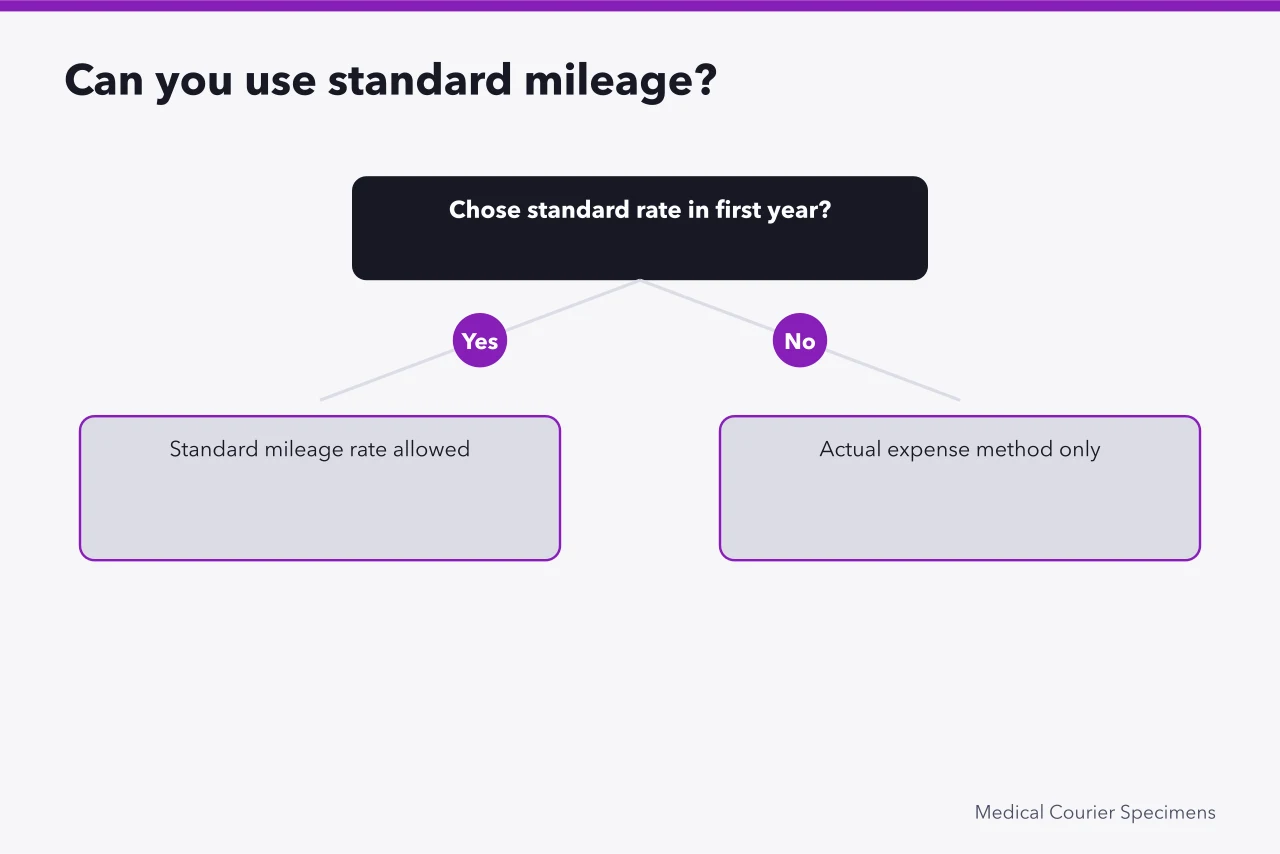
For most medical courier owners, the vehicle is a car, van, or SUV. You need a log that shows each trip. You cannot switch to the standard mileage rate after claiming actual expenses for that vehicle. If you lease the vehicle, you must stay with the standard mileage rate for the entire lease.
The IRS expects the log to be kept at or near the time of each trip. A weekly summary written from memory does not satisfy the contemporaneous record rule.
The numbered sequence
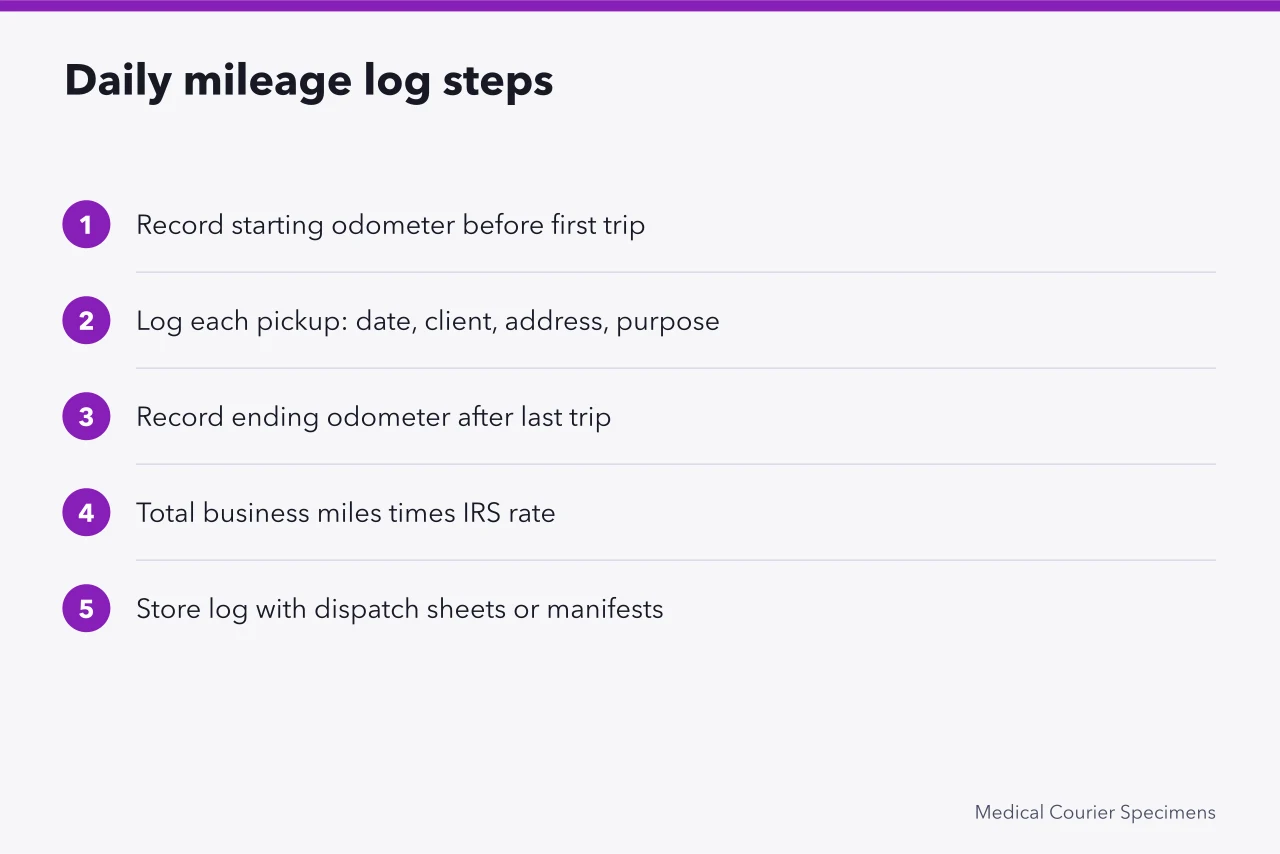
- Record the starting odometer reading before the first business trip of the day.
- For each specimen pickup or delivery, write the date, client or lab name, address, and a short business purpose such as "STAT pickup" or "specimen delivery".
- Record the ending odometer reading after the last business trip. Do not include miles from home to the first pickup or from the last drop back home.
- Total the business miles for the day, then multiply by the IRS rate for that tax year.
- Store the log with backup documents such as dispatch sheets or lab manifests.
For specimen-related records beyond the mileage log, see HIPAA records to know what to keep and for how long.
The step that decides the result
The step that decides the deduction is separating business miles from personal miles on every line. A mileage log with only daily totals is not enough. An IRS reviewer will look at the purpose column. If a trip can be read as personal or commuting, the deduction may be disallowed. Commuting miles between your home and a regular work location are never deductible.
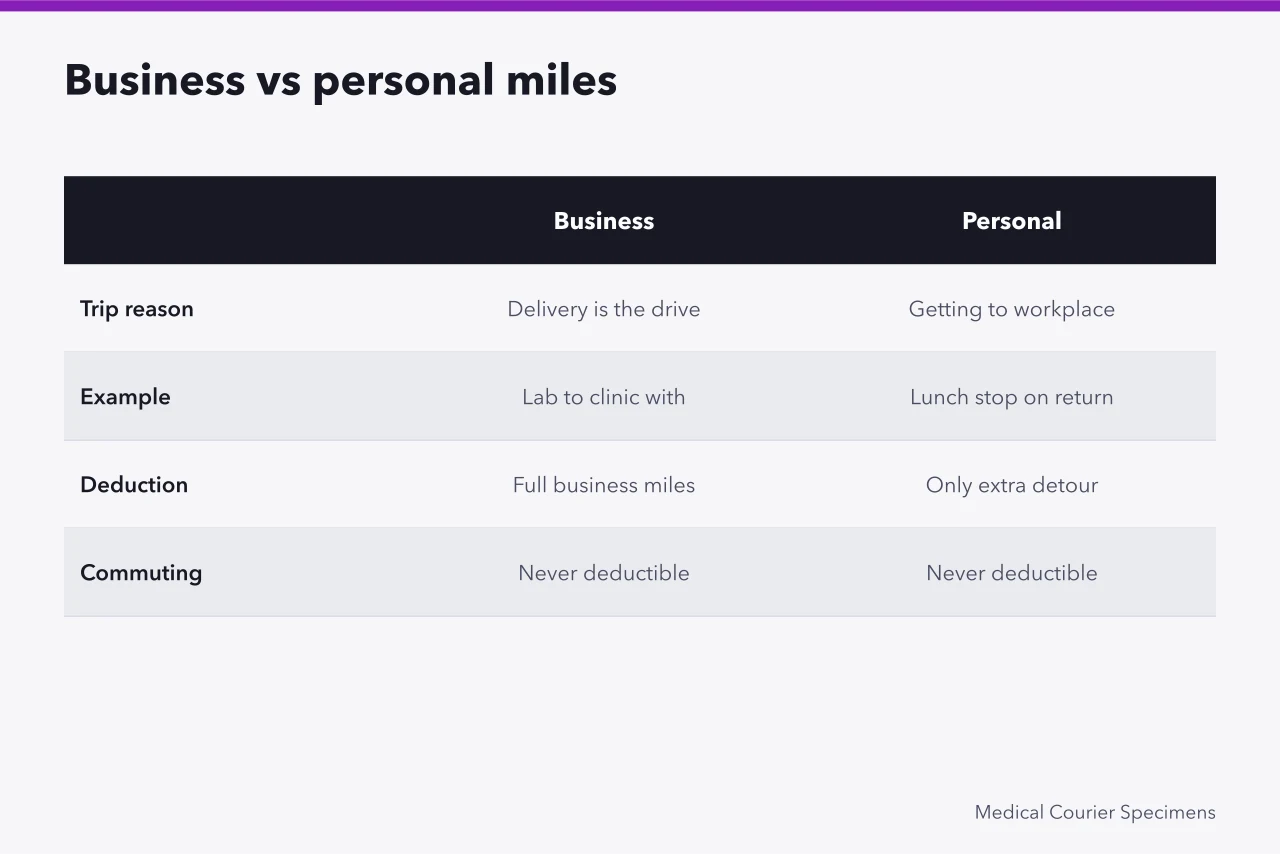
A trip becomes business mileage only when the delivery itself is the reason for the drive, not when you are simply getting to a fixed workplace.
For a medical courier, a trip from a lab to a clinic with specimens is clearly business. A stop for lunch on the way back is personal. Only the extra miles driven for the lunch detour should be excluded, not the entire delivery leg.
How to check each step came out right
Use a visible check. Compare the ending odometer from the last trip to the starting odometer the next day. If the two numbers do not match, a personal or unrecorded trip happened in between. Reconcile the log monthly with odometer photos or service records. The same review habit is covered in Quality control. You do not need a separate app. A paper notebook works if every line is filled at the end of each stop. Check that every row has all four fields filled.
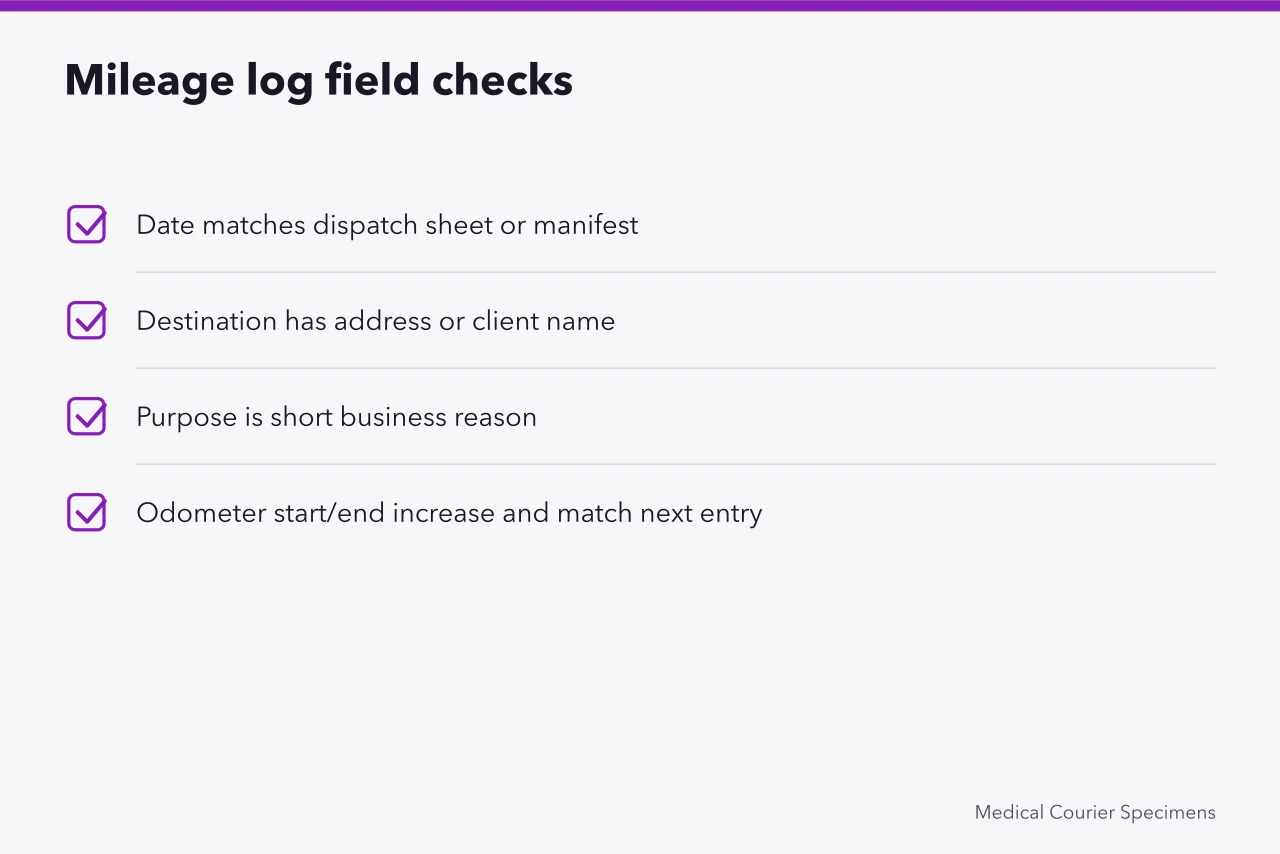
| Field | Visible check |
|---|---|
| Date | Matches dispatch sheet or lab manifest |
| Destination | Address or client name recorded, not just "specimen" |
| Purpose | Short business reason, not "drive" or "errand" |
| Odometer start/end | Numbers increase and match next entry |
What to do when a step goes wrong
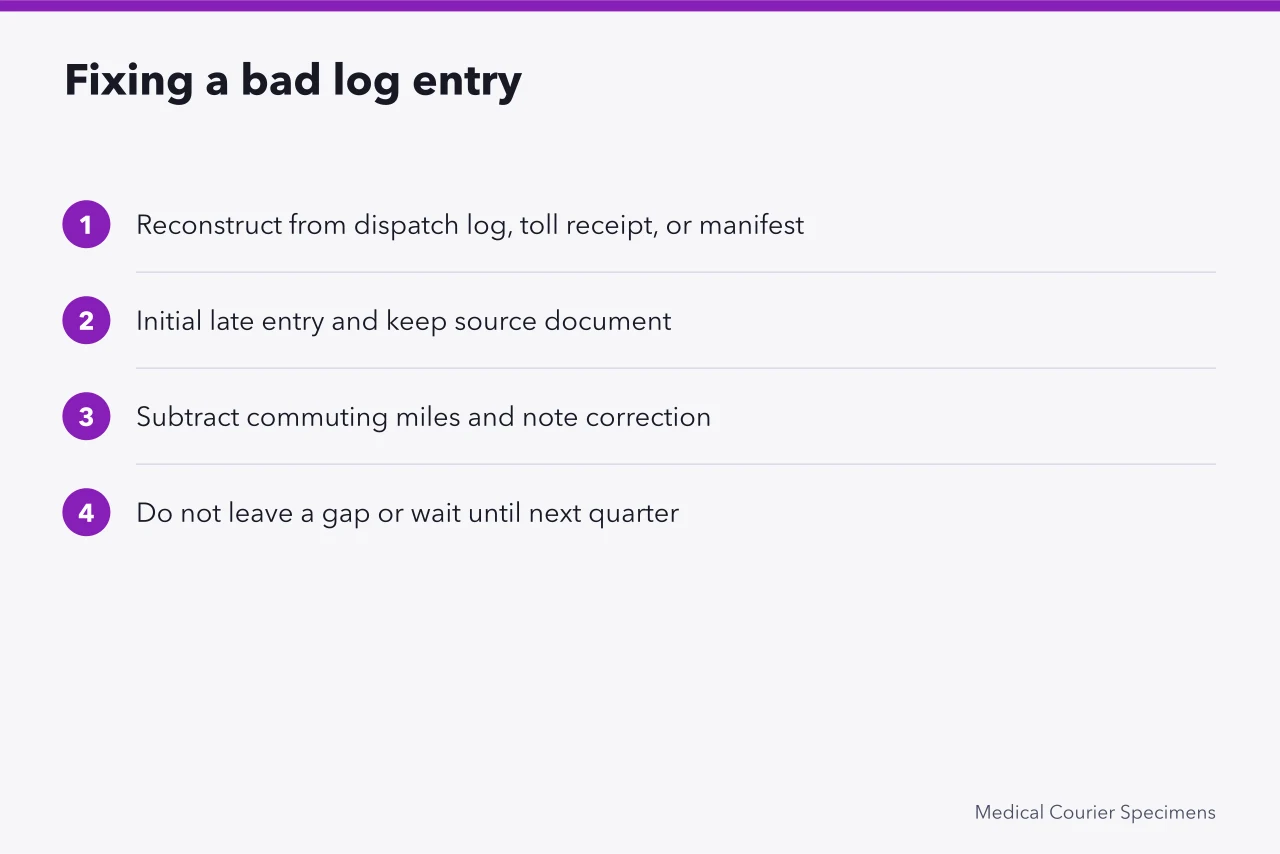
The common failure is a missing odometer reading or a forgotten personal errand inside a business day. If you skipped a row, reconstruct it from the dispatch log, toll receipt, or lab manifest before filing. Initial the late entry and keep the source document. If you included commuting miles by mistake, subtract them and note the correction. Do not leave a gap. Do not wait until the next quarter to fix a bad log. The IRS may treat a reconstructed log with no source document as unreliable.
Client manifests and Medical courier contract terms often list the pickup address and time, which can rebuild a missing entry.
When to stop and hand it to a professional
Stop and hand the mileage records to a tax professional when the IRS sends a notice about your vehicle deduction. Do the same when you have used both standard and actual methods on the same vehicle. Also stop when you cannot reconstruct more than a few trips in a quarter. A tax preparer can represent you and fix the method before an audit. This is also the point to review IRS mileage deduction for employee or contractor return differences.
California generally follows the federal standard mileage rate for personal income tax, but depreciation adjustments may differ if you change methods. Texas has no state personal income tax, so most couriers there need only the federal number. Check the state agency for your own return.
Common questions
Do I need a separate log for each vehicle? Yes. The IRS requires a separate mileage record for each car, van, or SUV used for medical courier work.
Can I use the standard mileage rate if my client pays me a per-mile reimbursement? If the reimbursement is accountable and tax-free, you cannot also deduct those same miles. Unreimbursed business miles remain deductible.
What counts as a business mile for a medical courier? A trip from one client location to another with specimens or supplies is a business mile. Driving from home to your first pickup is commuting unless you have a home office that qualifies as your principal place of business.
Does Texas have a state mileage deduction? Texas has no personal income tax, so the federal standard mileage rate is the only mileage deduction for most owner-operators in the state.