Guides
Medical courier contract terms for people who want the details
Fourteen medical courier contract clauses, each paired with the specific dispute it prevents, from the named site list to the specimen liability question.
What to take away
- Write each clause against a dispute you can name. A term that does not prevent a specific argument is filler.
- Four clauses do most of the work: the named site list, the waiting threshold, the change mechanism, and the specimen liability position.
- Silence always favors the party who reads the agreement most optimistically, and in this trade that is rarely the courier.
- Agree the exit terms while everyone is friendly. Nobody negotiates a fair handover during a dispute.
This page is not legal advice and states no legal position. Have any agreement reviewed by a qualified attorney in your jurisdiction, and read your insurance wording alongside it.
The fourteen clauses
1. The named site list. Every site by name and address, in a schedule. Prevents the dispute where sites are added by phone and served indefinitely at the original price.
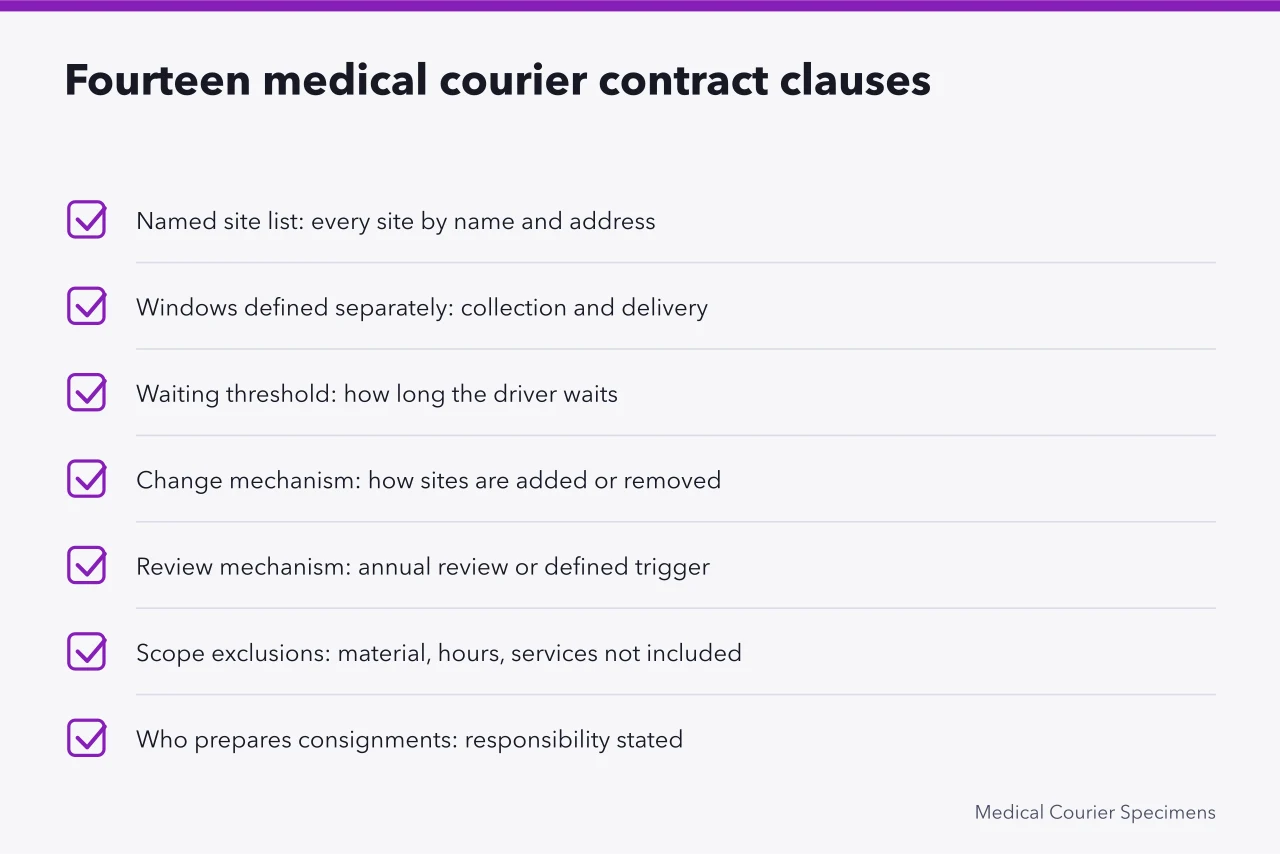
2. Windows, defined separately. A collection window per site and a delivery time at the destination, stated as two different things. Prevents the most common misunderstanding in the trade, where both parties quote the same sentence back at each other.
3. The waiting threshold. How long the driver waits at a site as part of the price, and what applies beyond it. Prevents the slow site from converting a per stop price into unpaid hourly work.
4. The change mechanism. How a site is added or removed, what notice each side gives, and that additions are repriced rather than absorbed. Prevents silent route growth, which is the most expensive thing that happens to courier contracts.
5. The review mechanism. An annual review, or a defined trigger tied to something the customer can verify. Prevents the situation where a rising cost has to be raised as a crisis instead of as an administrative step. How to construct it sits in the sales and proposal guide.
6. Scope exclusions. Material not carried, hours not covered, services not included. Prevents the reading in which anything not excluded was promised.
7. Who prepares consignments. A plain statement of which party prepares material for transport and who is responsible for packaging. Prevents an argument about duties after something has already gone wrong, and it needs to match reality rather than convenience. The framework it sits inside is PHMSA's guidance on transporting infectious substances safely, covering classification, packaging, marking, documentation and training.
8. The specimen liability position. What happens if a specimen is lost or its condition cannot be evidenced, and how far that liability extends beyond the item itself. Prevents the worst dispute in this trade, which is the one about consequential cost. Whatever position is agreed, check it against your insurance wording before signing rather than afterwards.
9. Evidence and records. What record you produce, in what form, how fast a copy is available, and how long each party retains it. Prevents disagreements about whether a run happened as described.
10. Exception handling. What each party does when a site is closed, material is not ready, packaging is wrong, or a vehicle fails, with notification timescales. Prevents the argument in which both parties believed the other was going to call.
11. Continuity. The cover arrangement and how substitution is notified. Prevents the customer discovering, on a bad day, that continuity was assumed rather than agreed.
12. Insurance. What each party holds, evidenced by certificate, and how a change is notified. Prevents a mid term surprise at exactly the point a claim is being made.
13. Term, notice and exit. Length, notice period, and what happens on the last day: final records handed over, equipment returned, and cooperation with an incoming provider. Prevents a departure that damages both parties' reputations.
14. Confidentiality and privacy conduct. How information is handled, what happens if a device or document is lost, and who is notified. Prevents a dispute where the customer's obligations were assumed to have flowed down and never actually did.
The four that matter most
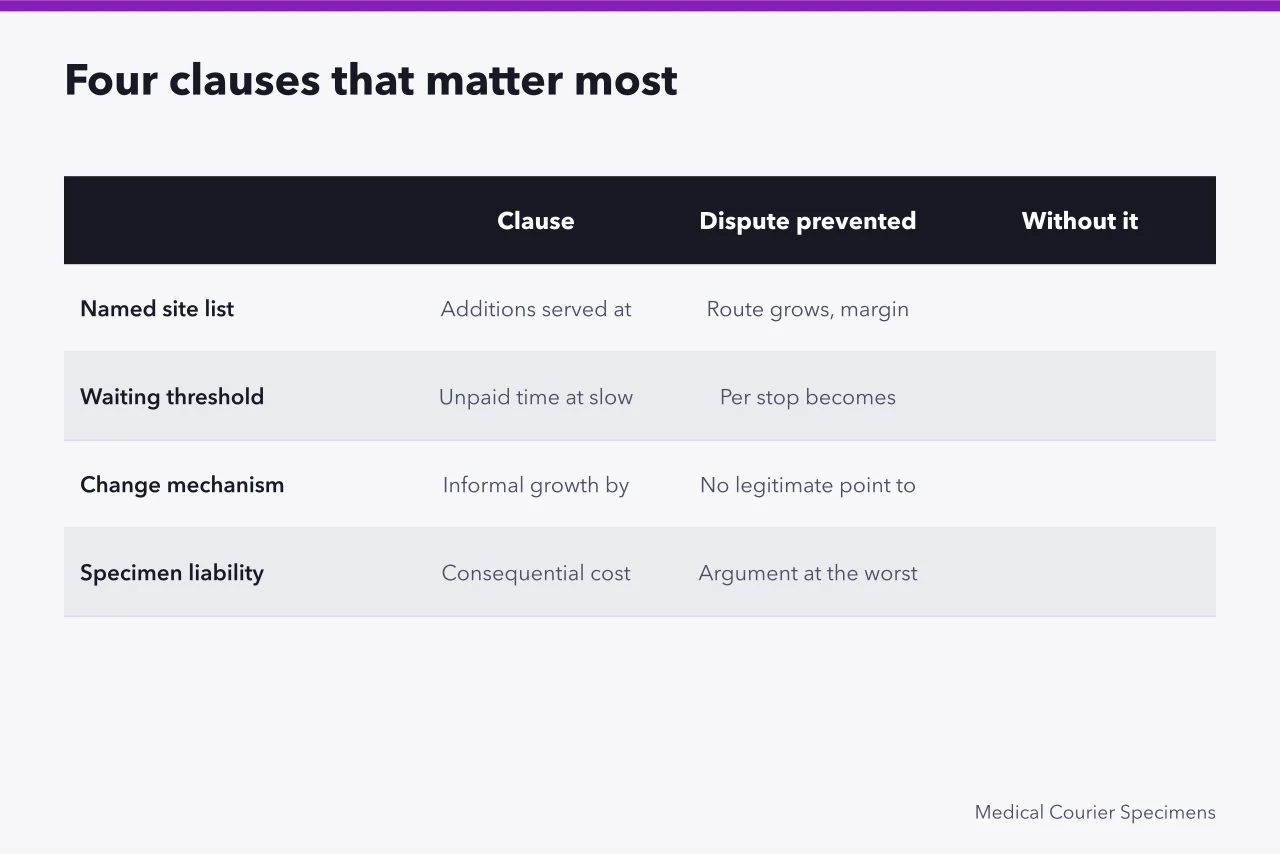
| Clause | The dispute it prevents | What happens without it |
|---|---|---|
| Named site list | Additions served at the original price | The route grows and the margin quietly disappears |
| Waiting threshold | Unpaid time at slow sites | A per stop price becomes an hourly job |
| Change mechanism | Informal growth by phone call | No point at which repricing is legitimate |
| Specimen liability | Consequential cost after a loss | An argument at the worst possible moment |
If time is short and only four clauses can be negotiated properly, negotiate these.
Terms that look harmless and are not
- An open ended service description. Anything phrased as all reasonable requests transfers an unbounded obligation to you.
- A service level with no measurement method. An on time percentage with no definition is a metric each side will calculate differently.
- A penalty clause with no matching cure period. Ask for a stated opportunity to correct before a deduction applies.
- Automatic renewal with a fixed price. Renewal is fine; renewal without the review mechanism is a locked in loss.
- Unlimited audit rights with no notice. Audits are reasonable and worth accepting; unannounced ones with no scope are not.
- A requirement to hold equipment you do not own, buried in a schedule. That is a cost of the contract, and it belongs in the price.
Make the operational clauses match the operation
Most courier contract breaches happen when someone agrees to a term operations cannot perform.
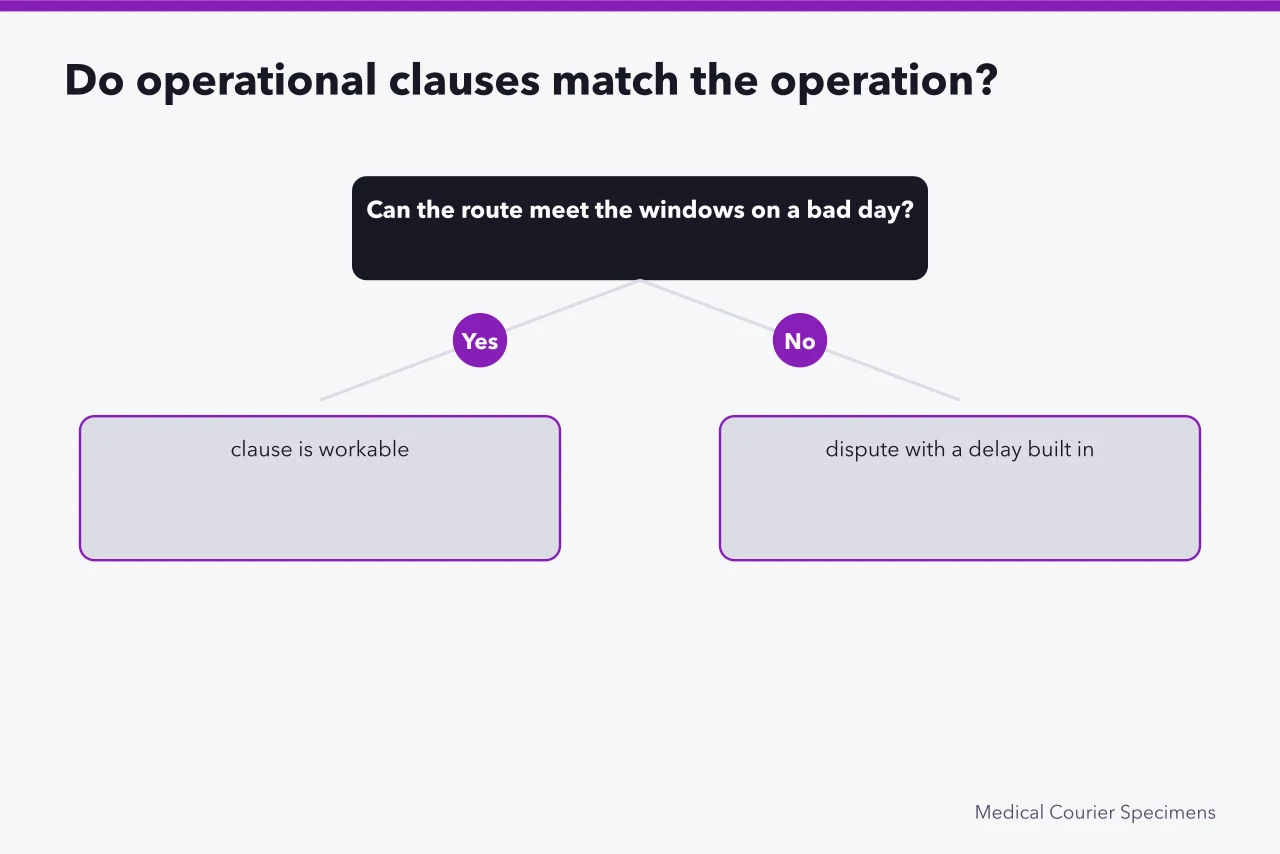
Before signing, check each operational clause against how the day actually runs. See the questions to ask on a discovery call and your submitted proposal, structured per the scope and fee sections of a proposal.
Three checks in particular. Can the route meet the windows on a bad day? Does the continuity clause describe an arrangement that exists? Is the waiting threshold consistent with measured dwell times at the actual sites? A clause that fails any of these is a dispute with a delay built in.
If the contract also stretches your territory, check that separately. Accounts that look attractive on paper and sit outside your density are how operators acquire routes they cannot escape, and the readiness tests are in which local markets support a courier route.
Keep the file
Retain the signed agreement, every schedule, the correspondence that amended it and the review records, together. The IRS guidance on records a business should keep sets the baseline for the financial records alongside it, and the practical rule is that an amendment agreed by email is only useful if you can find it two years later.
One more discipline. Marketing claims about the service must match the contract, because public claims need a reasonable basis.
The FTC guide to advertising for small business sets that standard. A website that promises more than the agreement delivers is a problem in both directions.
Common questions
Should I use the customer's contract or my own?
Large customers will use theirs. That is normal, and the work is to negotiate the four key clauses inside it rather than to insist on your document. Read the schedules carefully, because that is where the operational obligations hide.
What if the customer will not agree a waiting threshold?
Then price the risk instead, or move to an hourly basis for the affected sites. Accepting unlimited waiting at a per stop price is a decision, and it should be a conscious one.
Is a handshake agreement ever acceptable?
For a short trial with a written scope summary, sometimes. For ongoing work, no. The disputes above all become unresolvable when nothing is written down.
How often should the contract be revisited?
At the review date, and whenever the operation changes: new sites, new material, changed hours or a new protocol. A contract that describes last year's service is a liability rather than a protection.