Guides
How to Calculate a Medical Courier Fuel Surcharge That Customers Accept
Medical courier fuel surcharge formula: set a base EIA diesel index, adjust by the weekly change, and name the week in the contract. Customers accept a named week.
What to take away
- A medical courier fuel surcharge formula has three named parts: a base fuel index, a current fuel index, and a fuel consumption factor.
- Customers accept a surcharge when the contract names the exact EIA series and week, not a vague market price.
- The step that decides the result is the base week you lock into the contract.
- Each invoice line should show the same calculation so a lab accounts clerk can reproduce it in under a minute.
Start with the U.S. Energy Information Administration weekly U.S. on-highway diesel fuel index. That series is public, updated every Monday, and widely accepted by shippers and freight carriers. A medical courier fuel surcharge formula uses the difference between the current week and a base week, not a carrier's private guess.
What has to be true before the first step
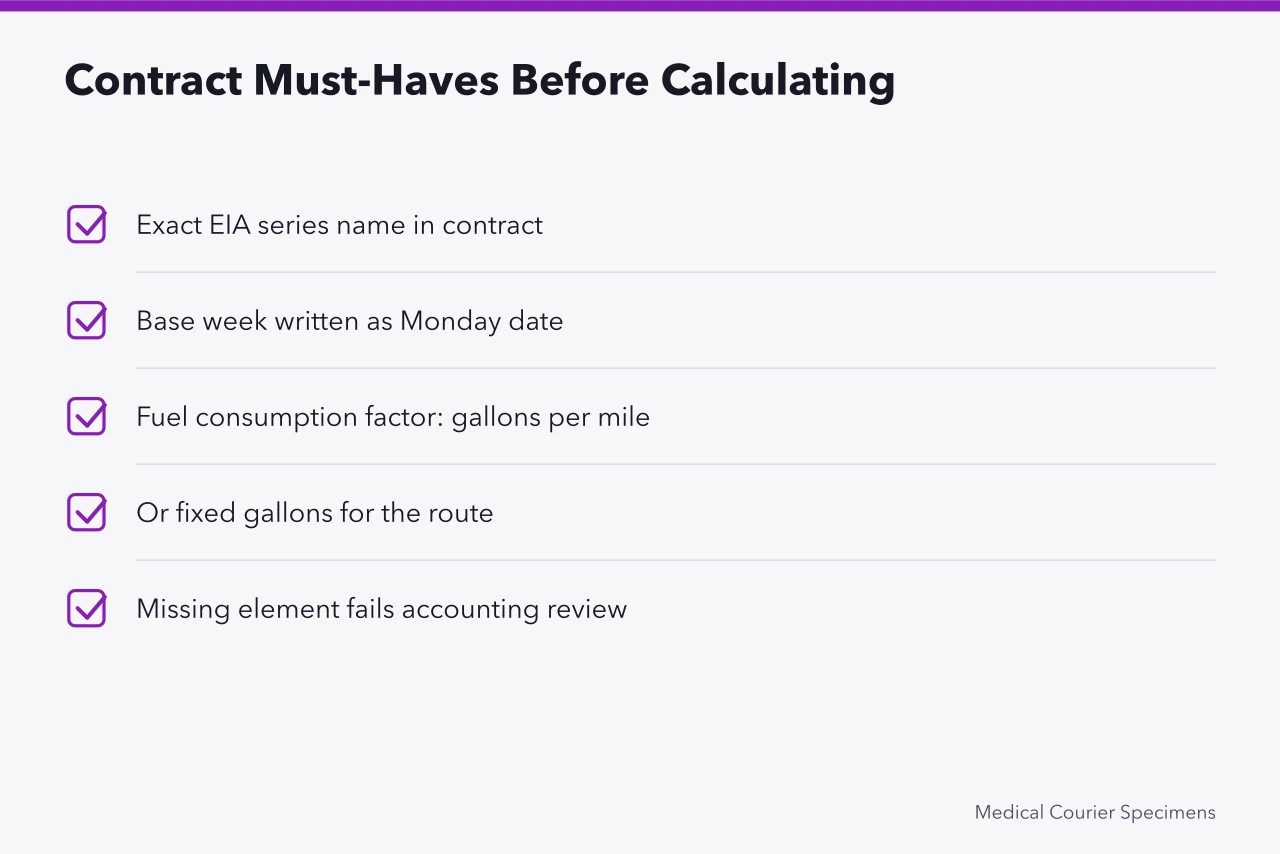
Before you calculate, the contract must contain three things. First, the exact EIA series name, such as U.S. On-Highway Diesel Fuel Prices, Weekly Retail, EIA. Second, the base week written as a Monday date. Third, the fuel consumption factor, either gallons per mile or fixed gallons for the route. If any element is missing, the invoice will not hold up in a customer's accounting review. The same clause belongs in the Medical courier contract terms you already use.
The sequence
Use a five-step sequence every billing cycle.
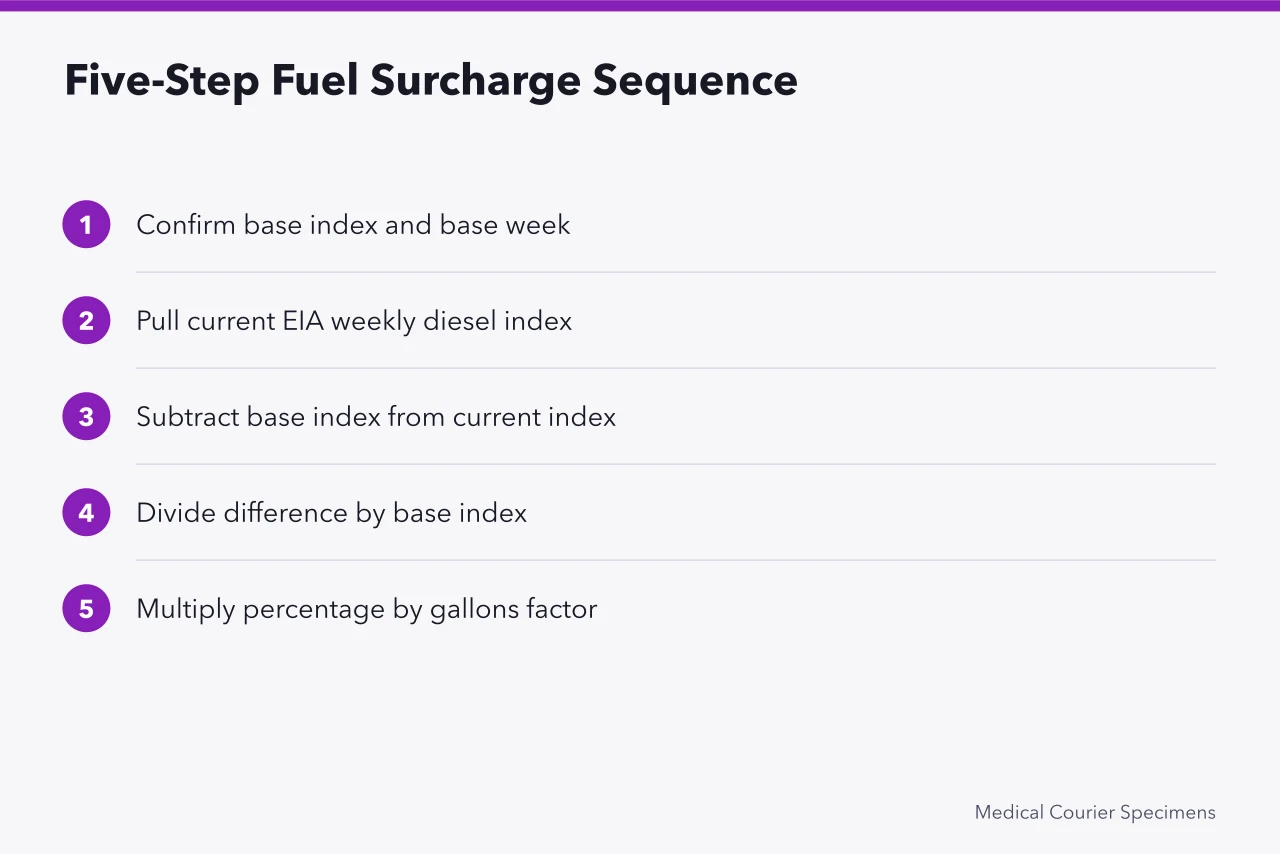
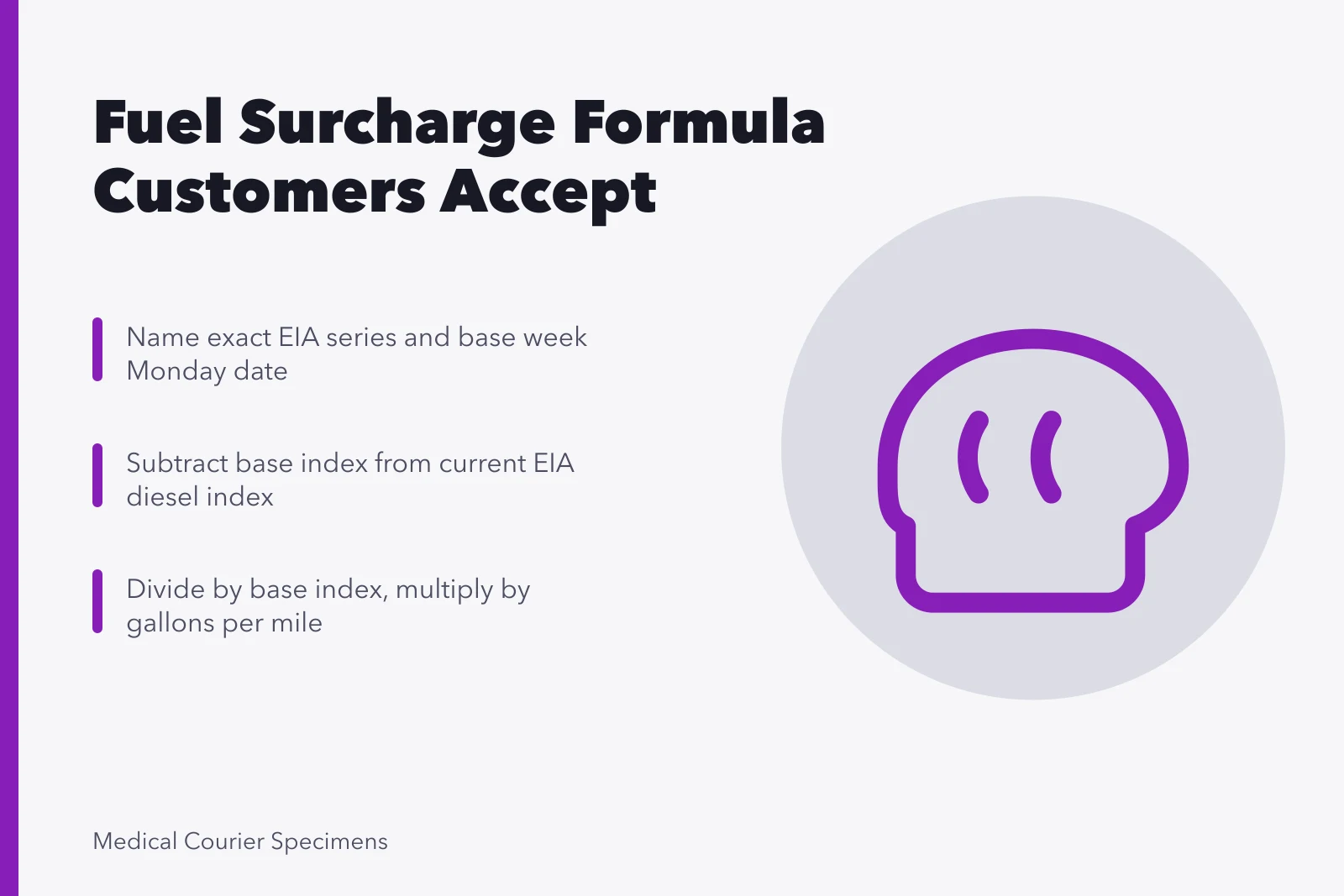
Written as a formula, fuel surcharge per mile = ((current index minus base index) divided by base index) times gallons per mile. The general fuel surcharge method uses the same arithmetic across freight and courier billing.
The step that decides the result
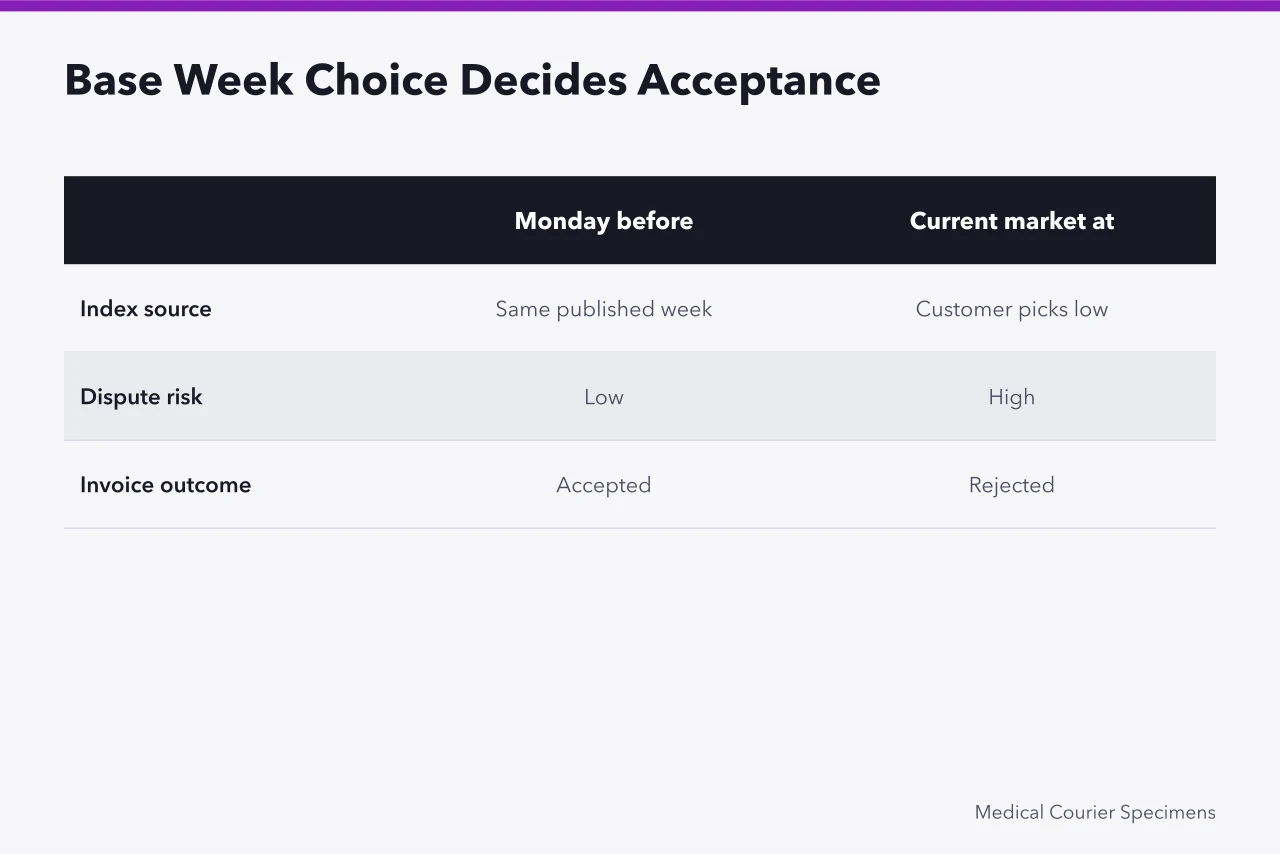
The base week is the step that decides whether customers accept the surcharge. If you set the base week to the Monday before the contract was signed, both sides can pull the same published index later. If you leave it as current market at time of quote, the customer will pick the lowest recent week and you will pick the highest. That is how a Pricing a STAT specimen run in a city like Los Angeles goes wrong before the first invoice.
Example
A Florida lab contract clause can read in plain terms:
Fuel surcharge per billed mile equals ((current EIA on-highway diesel index for invoice week minus base EIA index for contract week) divided by base EIA index) times agreed fuel consumption factor.
A Texas hospital lab account may prefer a per-run fixed gallon allowance. The clause names the route distance, the vehicle fuel economy, and the same EIA weekly series. Do not cite state average or regional diesel in either state. National EIA weekly retail diesel is the only series both parties can verify without a private data subscription.
How to check each step came out right
Use a written checklist before sending the invoice.
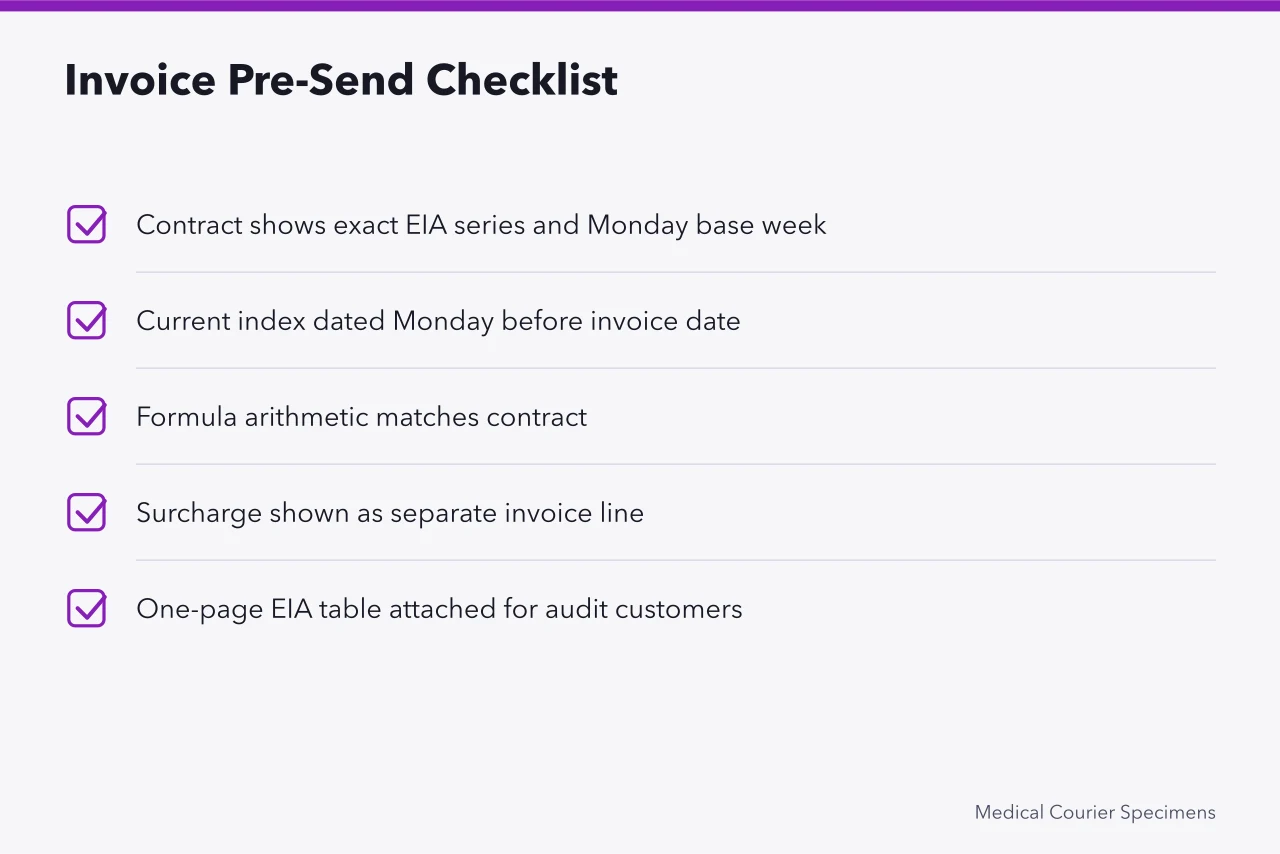
The mileage log should cross-check the same records described under IRS mileage deduction. For a customer with an internal audit requirement, attach a one-page EIA table to the invoice. The attachment shows the base week and the current week on the same chart. This is a visible check, not an estimate. If the customer uses a fiscal month different from the calendar week, note the mapping in the contract.
What to do when a step goes wrong
The common failure is an invoice that uses a different index week than the customer's payment cycle. A lab accounts clerk flags the line because the invoice Monday does not match the Monday on the EIA chart. Reissue the invoice with the correct Monday reference and a one-line reconciliation note. Do not renegotiate the formula before confirming the base week. Keeping the base week unchanged saves the clause from becoming a monthly negotiation.
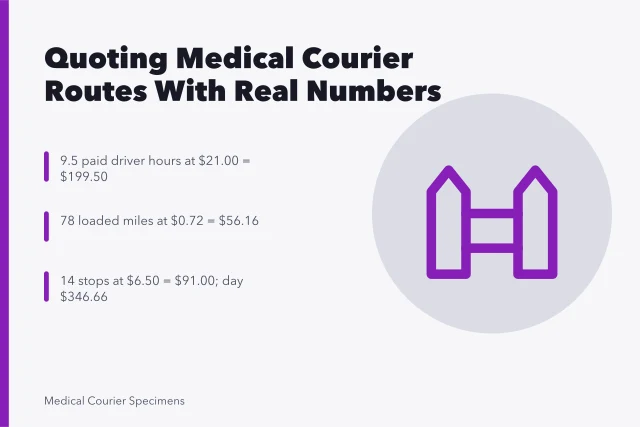
Before you reissue, compare the invoice with the template and real numbers you quoted. A second check is to confirm the gallons per mile factor still matches the route the driver actually ran. If the factor is stale, update it in the contract and tell the customer before the next cycle.
When to stop and hand it to a professional
Stop and hand the clause to a transportation pricing consultant or contract attorney in three cases. First, a customer wants a private proprietary index. Second, a sliding scale with caps and floors. Third, a multi-year contract with annual rebasing. Those structures change the legal risk, not just the arithmetic. For vehicle expense records, Publication 463 tells owners which miles and fuel receipts to retain.
Common questions
What is the most accepted fuel surcharge formula for a medical courier? Use the weekly EIA U.S. on-highway diesel index. Subtract the contract base index from the current index, divide by the base, and multiply by gallons per mile or fixed gallons.
How do I set a base fuel index that a lab accepts? Name the exact EIA series and the Monday of the week the contract was signed. Avoid regional or private indexes.
Can I use the same formula for W-2 and 1099 drivers? Yes, the invoice is separate from driver pay. Driver reimbursement follows IRS rules, which is a different record set.