Guides
Medical courier demand signals to watch in 2027
Seven forces changing medical courier demand, what each one would look like locally, and the question to ask so you see it before your competitors do.
What to take away
- No forecast appears here. Nobody can tell you what specimen volumes will do in your territory, and a page that says otherwise is guessing with confidence.
- What can be described are forces already visible, and what each one would look like where you operate if it were reaching you.
- The most useful habit is a quarterly question put to the people who actually know: your customers. They see the change before any publication does.
- Most trends in this trade change the shape of the work rather than the amount, and shape is what your route design and pricing have to absorb.
Nothing here states a statistic, projection, market size or growth rate. Where a number would be needed, the text names who to ask instead.
How to read a trend without a forecast
A force worth acting on has three properties: you can see it locally, you can name what would change in your routes if it grew, and you can ask somebody a question that would confirm it. Anything without all three is background noise.
For each force below, the second column of the table is the part to act on.
The seven forces
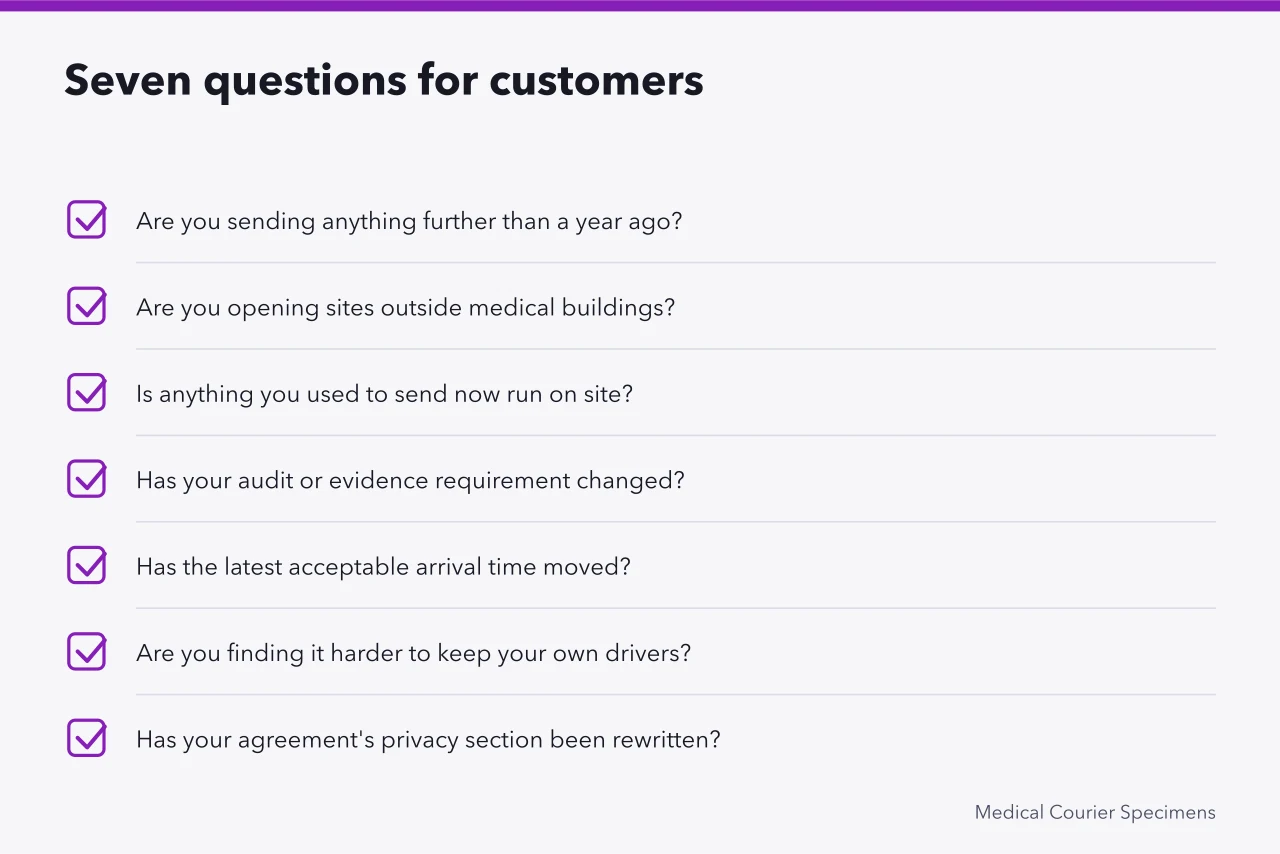
| Force | What it would look like in your territory | The question to ask |
|---|---|---|
| Consolidation of laboratory services | Fewer, larger receiving points and longer hauls from the same clinics | Are you sending anything further than you were a year ago? |
| Care moving out of hospitals | More small collection sites in retail and neighborhood settings | Are you opening sites that are not in a medical building? |
| Testing performed closer to the patient | Fewer routine specimens from some sites, more urgent exceptions | Is anything you used to send now being run on site? |
| Rising documentation expectations | Customers asking for condition records they did not ask for before | Has your audit or evidence requirement changed? |
| Pressure on clinical turnaround | Tighter receiving windows rather than more volume | Has the latest acceptable arrival time moved? |
| Labor market tightness | Longer hiring times and higher pay for the same role | Are you finding it harder to keep your own drivers? |
| Scrutiny of privacy and device handling | Contract clauses about devices, notification and access | Has your agreement's privacy section been rewritten recently? |
Ask those seven questions of two or three customers each quarter. It takes one conversation and it is better intelligence than anything you can read, because it is about your market rather than about markets in general.
What each force does to the work
Consolidation and longer hauls change the arithmetic rather than the volume. A route that used to end nearby now ends further away, which eats the buffer and can push the last collection earlier. Watch the arrival variance before a customer raises it.
Care in more places raises site count and lowers volume per site. That favors operators who price for density and hurts anyone priced per stop with long dwell. It also multiplies the number of handover relationships you have to manage.
Testing closer to the patient is the force most often described as a threat. In practice it changes the mix: fewer routine collections from some sites, and a residue of work that is urgent, unusual or condition sensitive. That residue is not lower value work, but it does need standby capacity, and it needs pricing that reflects availability rather than stops.
Documentation expectations are the force with the clearest operational consequence. If a customer starts asking for condition evidence, that is an equipment and process decision before it is a sales one, and the systems view is in the equipment and setup guide.
Tighter windows compress route design rather than expanding demand. The answer is usually re-sequencing or a second run, not a faster driver.
Labor tightness is felt in retention before it is felt in recruitment. Check what the role commands where you operate using the BLS occupational employment and wage tables, which give employment and wage estimates by occupation for national, state and metropolitan areas, and read it alongside your own turnover. The retention side is in the hiring and training guide.
Privacy and device scrutiny arrives as contract language rather than as news. Read the agreement clauses when they change, and ask what the customer expects operationally rather than assuming your current practice satisfies it.
What does not change
Obligations for moving clinical material stay in place. Classification sets packaging and handling, training attaches to the role, and evidence must exist and be retrievable.
PHMSA's guidance on transporting infectious substances safely sets the transport framework: classification, packaging, marking, documentation and training. The full regime map, including which body owns which question, is in which rules govern medical courier work.
An operator who reacts to every trend and lets the evidence standard slip has made themselves less valuable, not more current.
Turning a force into a decision
- Confirm it locally with the quarterly questions rather than from a publication.
- Name what would have to change in your operation: route design, equipment, staffing, pricing.
- Cost that change, including the interval before revenue follows.
- Decide whether to act now, prepare quietly, or watch for another quarter.
- Write the trigger down, so the decision is made by evidence rather than by whoever raised it last.
Free counseling on planning that kind of change is available through the SBA business guide and adviser network, which covers the plan, manage and grow stages at no charge and connects owners to local advisers.
For a force aiming at a new territory, not a new service, the territory scoring method is in which local markets support a courier route. Readiness tests before any move are in the guide to adding routes and territory.
What to watch in your own numbers
Trends show up in your data before they show up anywhere else. Four figures worth watching for shape rather than for level:
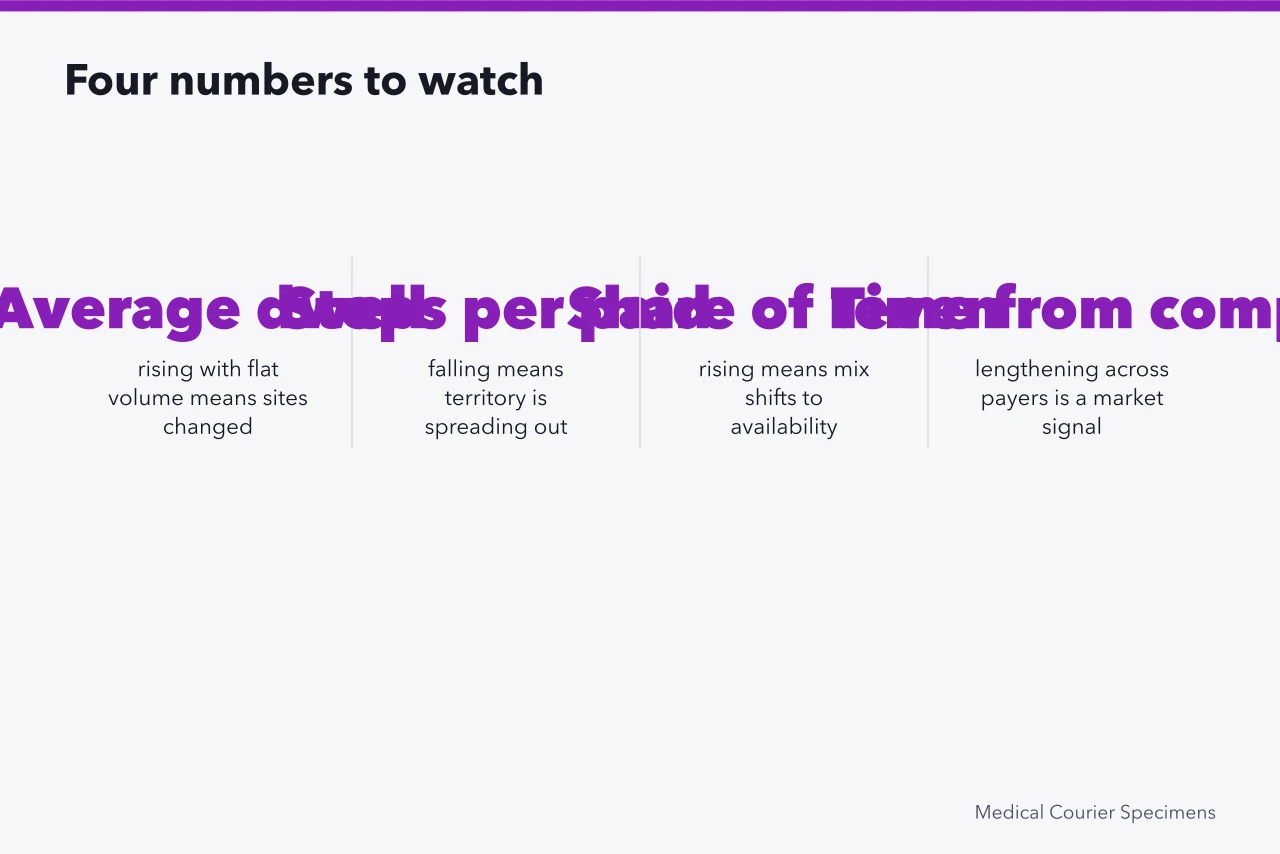
- Average dwell time across all sites. Rising dwell with flat volume usually means the sites themselves have changed.
- Stops per paid hour. Falling despite stable volume means the territory is spreading out.
- Share of revenue from unscheduled work. Rising means the mix is shifting toward availability.
- Time from completion to cleared payment. Lengthening across several payers is a market signal, not an administrative one.
Common questions
Will demand for medical courier work grow?
Nobody can tell you that for your territory, and any page that names a figure is inventing it. What is knowable is the direction of the seven forces above and what your own customers say when asked directly.
Should I invest ahead of a trend?
Prepare cheaply, commit late. Writing a procedure and asking a supplier a question costs almost nothing; buying capacity for a trend that has not reached you is the expensive version of the same instinct.
Which force matters most to a small operator?
Labor, in most markets. Every other force is absorbable if you can staff the work, and none of them are if you cannot.
How do I avoid reacting to noise?
Require the three properties: visible locally, a named operational consequence, and a question that would confirm it. Most industry commentary fails at least two of those.